
70 Years of the Routemaster
02 April 2026
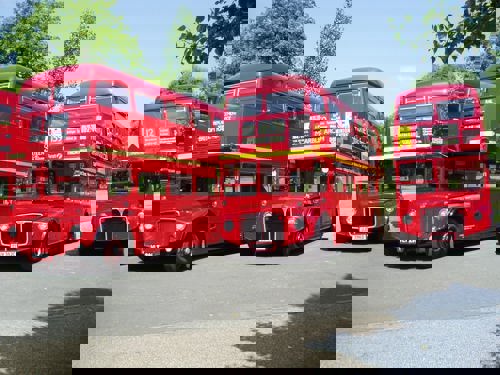
On the 8th of February 1956, Londoners waited for the No.2 bus on the Golders Green to Crystal Palace route - a bus that would make transport history. The double-decker, registration SLT 56, was the first Routemaster to enter service. This trio of Jeremy Clarke are tribute to a vehicle that became an essential part of life in the capital, so here are 20 facts about this remarkable vehicle:
1. The Routemaster’s innovations included power-assisted steering, a heating system for the interior, front suspension via independent coil springs, a four-speed semi-automatic gearbox, and flashing indicators front and rear.
2. The crew of the Routemaster benefitted from a cubby hole for the conductor, and a sliding driver's door.
3. The London Transport Board began planning the Routemaster in 1947, with the aim of it being lighter and easier to operate than the RT, which entered service in 1938.
4. By 1952 the London Transport Executive, as the organisation was now known, decided the Routemaster should accommodate 64 passengers, compared with the RT’s 56.
5. The Associated Equipment Company Ltd (AEC) of Southall would be responsible for the engineering.
6. London Transport specified running gear mounted on detachable sub-frames to make overhauls easier.
7. A.M. Durrant and Colin Curtis headed the Routemaster development team.
8. By 1952, London Transport approached the great industrial designer Douglas Scott with a commission for the Routemaster’s styling.
9. Scott’s involvement with the Routemaster was such that he even devised the burgundy and tartan moquette seat upholstery.
10. The seats were designed to deter pickpockets sat behind a potential victim.
11. Unions vetoed Scott’s original idea for a full-width cab, as they believed such a layout would cause problems for drivers.
12. London Transport evaluated the Routemasters on the Ministry of Supply’s fighting vehicle proving ground.
13. The Routemaster starred at the 1954 Commercial Vehicle Motor Show
14. On the 28th of September 1956, London Transport announced that they had ordered a fleet of 850 Routemasters.
15. That day, London Transport also told the public that the Routemasters would start replacing the capital's trolleybus network from 1959 onwards. Diesel-powered buses were said to have greater mobility in traffic, freedom from mass-holdups and greater route flexibility. The final London trolleybus ran in 1962.
16. On its maiden voyage, RM1’s heating system failed to work.
17. In 1956 London Transport received complaints from some passengers that the Routemaster’s seats were not soft enough. Other complaints were that it could not accommodate as many passengers as the 70-seater trolleybuses.
18. RM1 originally had no external grille, but crews encountered problems with poorly ventilated brakes, while the radiator mounted under the floor behind the driver was impractical. When London Transport displayed RM1 at the 1956 Lord Mayor's Show that November, it had a front-mounted radiator with vertical air intakes in the front panel.
19. RM1 gained the now-familiar Routemaster grille in 1964 and it was sold to the Lockheed Corporation in 1972.
20. London Transport re-acquired RM1 nine years later, and it is now a member of their historic fleet.
With thanks to Jeremy Clarke for his time.
With thanks to Jeremy Clarke for his permission to use the images in this blog.