
MEET THE OWNER – TIM MORGAN AND HIS ROVER 75
16 February 2026
It is like a baby Bentley - gorgeous green leather interior with thick pile carpets and real tree on the dashboard. It makes wonderful burbling noises as you waft along in supreme comfort - all for under £2,000. They won’t stay this cheap forever…
Tim Morgan will be known to many readers as an expert on Hillman Imps – and so many other cars. The most recent addition to his fleet is a Rover 75 Connoisseur, and it can be said that it is a classic vehicle that is finally receiving the respect that was always its due. When new, The Telegraph said the 75 was “a very fine-looking car indeed, easily the match of the sleek new Jaguar (S-Type), with just the right amount of retro-feel without being gooey and misty-eyed about the past”.
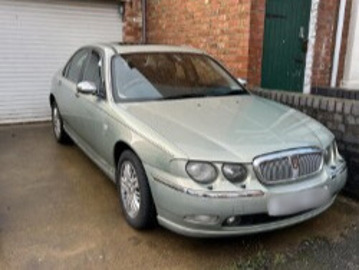
What Car hailed the new Rover as their Car of the Year: “The 75 sets new standards of styling, interior design, ride comfort and refinement in a hugely demanding class. It shows that Rover has the ability to compete head-on with the world’s best car makers”.
Looking at Tim’s Rover, it is almost impossible to believe that it debuted on the 20th of October 1998. Those of us who remember that era might also recall the strange air of combined optimism and trepidation that surrounded the 75’s launch. It was not just that it had to replace both the 600 and 800, for Car magazine referred to the 75 as “Rover’s last chance saloon”.
However, BMW had acquired Rover in 1994, and its financial input had resulted in a £250m virtual rebuild of the Cowley plant. The CEO of Rover stated that the 75 was their first product developed in recent years without compromise. The company initially planned to unveil the 75 at the Geneva Motor Show in March 1999, but it opted for the NEC in 1998 to steal the thunder of Jaguar’s new S-Type.
When sales commenced in June 1999, the Rover 75 looked set to be the car of choice for those motorists who valued modernity overlayed with past design tropes. Not everyone appreciated this approach, and Alexei Sayle wrote in Car:
In a car of such modest proportions, it was as if a team of surreal burglars had entered your house and rammed a three-piece leather suite, a giant-screen TV, a boss stereo, a highly-polished mahogany sideboard and a load of cream-faced clocks into your small back bedroom.
However, Tim’s 75 shows that Rover’s approach was reassuringly understated, never lapsing into pastiche. Mr. Sayle further wrote that “Rover trumpets the 75 as the best front-drive car ever, and in my fairly limited experience it is right”.
Alas, James Taylor’s indispensable book Rover 75 and MG ZT: The Complete Story notes how “By the time of the 75’s launch in October 1998, the German company’s patience was already wearing thin”. By the following year, “there was a strong faction within BMW in favour of severing the ties between the two companies”.
Indeed, on the day of the 75’s launch, BMW’s CEO, Bernd Pischetsrieder, made a statement about the future of Rover in the UK. As Keith Adams writes in the always fascinating www.aronline.co.uk:
At 4.30pm, Pischetsrieder finally stood up and addressed the assembled journalists. He pulled no punches – essentially, Rover was mired in a deep crisis, and drastic action would be needed to safeguard production at Longbridge. ‘Short-term actions are required for the long-term future of the Rover Group,’ he said. ‘Talks are taking place with the British Government about the problem.
The 75 had the misfortune to be yet another crucial new model in the post-British Leyland saga, launched against the background of corporate upheavals. In a kinder world, it would have been the keystone to a dynasty of Rover and MG saloons. But, as history relates, BMW sold Rover to the Phoenix Consortium in 2000, and in April 2005, they called in the administrators.
In a strange way, this historical background is why 75s such as this green Connoisseur are now becoming prized among collectors of all ages. There is a growing appreciation of how they were not only the last-of-the-line but a car that denoted an alternative future for Rover.
And there is a sense of poignancy when you read of the celebration to mark the start of official sales on the 17th of June 1998. 75 Rovers, in red, white and blue, were arranged at a car park near Tower Bridge. The Royal Philharmonic Orchestra serenaded the lineup with the fanfare Arrival, composed by Dave Stewart, with Vanessa-Mae playing violin while kneeling on the roof of one of the Rovers.
It was akin to the dying embers of ‘Cool Britannia’ meeting the ghost of Vivian Stanshall – but perhaps that encapsulates the Rover 75’s appeal.
With thanks to Tim Morgan for his time.
With thanks to Tim Morgan for the permission to use the images in this blog.