
The 190c – The Fintail That Came In From The Cold
16 February 2026
In 1965, contemplating a new Mercedes-Benz in the UK was for the well-heeled. Even the entry-level four-cylinder 190c ‘Fintail’ cost £1,727 – over £600 more than its nearest British rival, the Humber Hawk. For another £61 you could have bought the top-of-the-range Humber Imperial, while a Jaguar 3.8 Mk. 2 would have set you back just £1,605 and a Daimler 2 ½ Litre V8 £1,647. You might have also considered a Rover 3-Litre Saloon Mk. II for £1,708, and a Wolseley 6/110 Mk. II was a mere £1,180.
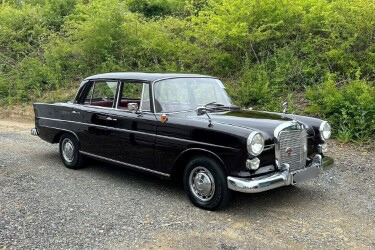
But your friendly local dealer would have told you that the social distinction of owning a car with the Mercedes Benz logo was above mere £sd inflated by import duties. In 1963, the concessionaire asked, “Why not prove for yourself the advantages of owning the Mercedes 190?” Such assumptions were due to its “superbly aristocratic appearance”. Furthermore, the 190c was built to the same very exacting standards as the top-of-the-range 300SE.
Daimler-Benz commenced work on the ‘Fintail’ in 1956. The design criteria were more cabin room than the existing ‘Ponton’ saloons, and have a timeless appearance. The body was to employ the “cell” principle created by the company’s Safety Engineer, Béla Barény, and the result had to be immediately recognisable as a Mercedes-Benz.
The W111 220/220S/220SE series debuted in 1959 and soon gained the nickname ‘Heckflosse’. Some Daimler-Benz managers were not overly keen on the fins, but their intention was as “Pielstege” (guide rails) for ease of parking. In 1961, Mercedes-Benz introduced the 3-Litre W112 300SE and, as the replacement for the 190 Ponton, the W110 190c.
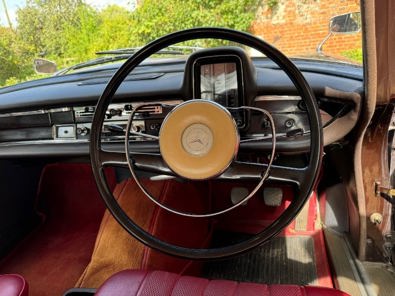
The 190c had a 1,897cc 4-cylinder engine, and the body combined the W111's cabin and boot with a shorter bonnet and wheelbase. One distinctive feature was the wing-mounted front indicators, as previously featured on the 190 Ponton. M-B promised “discreetly used chrome decor to enhance the beautiful form of the car” while “‘Fashionable’ frills have purposely been avoided”. You could also convert your 190c into a six-seater by specifying two bolsters for the front seats. These were inserted into the central oddments tray and between the backrests to create a front bench.
Plus, calling Mercedes-Benz GB on Isleworth 2151 to place an order for a new 190C might have two consequences. The first was most of your neighbours regarding you as frightfully wealthy and mysterious, and the second was others wondering if you were somehow involved in the Cold War. In Germany, a 190c was a car for a bank manager, while in the UK it would lurk menacingly in the background of Funeral in Berlin or The Quiller Memorandum.
The 200 Fintail replaced the 190c in 1965, and the last of the Heckflosse range left the factory in 1968. This 190c still conveys the air of a Cold War drama - cue the John Barry music...
With thanks to Total Headturners for their time.
With thanks to Total Headturners for the permission to use the images in this blog.