
Meet The Owner – Andrew Stimson and his Ford V8 Pilot
27 February 2026
My first sighting of the Ford V8 Pilot was seeing the 1956 Ealing crime thriller The Long Arm on afternoon television. Superintendent Jack Hawkins is on the trail of a getaway car, a black V8 Pilot which a sharp-eyed PC Nicholas Parsons discovers abandoned in a scrapyard. By contrast, Andrew’s immaculate example was ordered in 1950 by Thomas Wilkins, the owner of Wilkins Jams in Tiptree, who owned it for nearly 30 years.
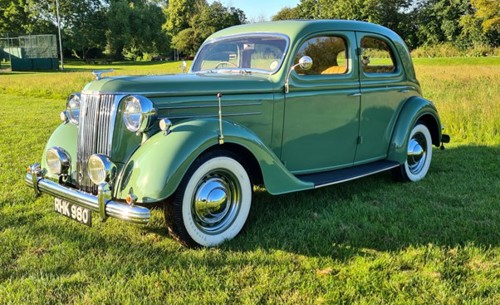
He only used it in the spring to visit farmers. It was then serviced at the factory and put in storage until the next year. I have a framed letter from the factory, confirming it all (when a previous owner enquired if Wilkins wanted to buy it back many years later).
Ford launched the V8 Pilot in August 1947:
As their first new post-war product. Its styling, based on the pre-war model 62, was finalised shortly before it debuted.
Dagenham initially planned to use a 2,535cc engine, but “after further research into overseas markets, it was decided not to proceed” with this unit. It is believed that Ford made only six 2.5-litre Pilots before introducing the 3.6-litre V8 plant in November 1947. Andrew explained this was “a British motor but based on the US version. Unfortunately, hardly any parts are interchangeable”.
The brochure claimed that the Pilot was “un-baffled by the steepest hills, unruffled by slow traffic speeds”. A steering column controlled the three-speed transmission, and the specification included a heater, a rear window blind controlled by the driver and a ‘Smith’s Jackall’ integral jacking system. You could even aspire to own the Pilot De Luxe with leather upholstery and even an Ekco radio, while the colour choices were green, black, dark blue or beige.
Inside, the Pilot's proud owner could highlight the cigarette lighter, the clock, and a rear folding armrest.
Andrew points out that “the dashboard is reputedly the largest piece of Bakelite made”, while the but few British motorists, even if they were in the happy financial position to afford £748 5s, could expect to take delivery of a Ford Pilot - “a car for the connoisseur” for quite a while.
In 1947, the government decreed that the UK’s motor manufacturers needed to export 75% of their output to be eligible for a steel quota. On the 14th of August of that year, Sir Rowland Smith, the Managing Director of Ford GB, told the press: “Few motorists can expect early delivery. The Dagenham factory will do its best – it cannot do more”.
As a result, many Pilots were exported to Commonwealth countries, while the domestic waiting list for a Ford Pilot lasted for literally years. Even if you were fortunate enough to take delivery, there was a used car covenant that you would not sell it within six months. By 1948, this period last for two years.
In terms of rivals, the Pilot’s main competitors were the Humber Hawk and the Wolseley 6/80, but these had four and six-cylinder engines compared with the Ford’s V8 plant. Andrew finds this unit well-suited to the Pilot, while the styling is rather handsome in a mid-Atlantic fashion.
Not that Pilot could be accused of being flamboyant: Sir Rowland Smith apparently advised his designers to avoid the ‘cinema organ’ look. Instead, as Ford put it, the V8 Pilot will “stand out impressively in any car gathering” - a vehicle to impress the factory owner and the young Arthur Daley alike.
The V8 Pilot saloon ceased production in 1951, the year after Ford introduced the monocoque-built Zephyr-Six, although it arguably had no direct replacement until the 1953 Zephyr-Zodiac. As for Andrew’s Pilot:
It was registered on 12th July 1950 to Thomas Wilkin of Wilkin & Sons (Preserves & Marmalade) of Tiptree. Thomas was the owner of the company and used the Pilot as his ‘Farm Car’ to visit local produce growers around Essex. Each year, after being used, it was returned to the factory, greased and serviced, then stored away until needed again.
Tiptree sold the Pilot in December 1979 to its second owner, who refurbished the paintwork and recovered the front seat in tan leather. The Ford went on to change hands in 1987, 2009, and 2011. Andrew bought the Pilot in August 2023, and says:
The car has never been welded underneath or had any major repairs, with only a few modern upgrades such as electronic ignition and a 6-volt alternator. It is still running its original 6-volt positive earth electrics and has only covered just over 41,000 genuine miles from new - in 76 years! Not bad for an old ‘Farm Car’!
Naturally, Andrew revels in the Pilot’s idiosyncrasies, such as ventilation via opening the windscreen, and, as with all UK-built Fords until 1959, vacuum-powered wipers. However, in his view, “they are not at all bad, and many people forget that you can adjust their speed. The Pilot’s hydro-mechanical brakes can take a little getting used to, but it is a wonderful car”. Andrew particularly enjoys the radio, with its ‘Home’, ‘Light’ and ‘Third’ symbols, even if it can no longer receive episodes of Dick Barton – Special Agent.
Maybe the best aspect of any classic car is the memories it evokes and when Andrew attended a local car show, he met with another enthusiast:
He read the write up and then asked, ‘are you sure its old man Wilkins’ old Pilot?’. Once confirmed, he said that he actually sat in the back of it about 65 years ago, when Thomas took him and a group of lads to play football!
The gentleman Andrew met at the show used to live next door to the Tiptree factory in Tiptree and amazed that the Pilot survived. And who could put a price on such moments?
With thanks to Andrew Stimson for his time.
With thanks to Andrew Stimson for his permission to use the images in this blog.