
The Renault Dauphine at 70
27 February 2026
To celebrate – 70 facts about one of Renault’s most important cars -
- In 1949, Renault’s CEO, Pierre Lefaucheux, anticipated a time when French motorists would demand more comfort than their 4CV could offer.
- Development of ‘Project 109’ commenced in 1951 under Fernard Picard, the head of Renault's design office.
- Luigi Segre of Ghia assisted with creating the Dauphine’s bodywork.
- Renault commissioned the textile designer Paule Marrot to assist with the Dauphine’s colour schemes and interior design.
- The first prototype was completed in July 1952.
- Renault planned to call the Dauphine the Corvette, but in 1953, General Motors used this name for their new Chevrolet sports car.
- Legend has it that a Renault employee suggested that if their 4CV was ‘The Queen’, then the new model should be the Dauphine - ‘Crown Princess’.
- The company displayed their ‘5CV’ to the press in November 1955.
- The official launch took place at the Palais de Chaillot on the 6th of March 1956.
- The brochure claimed that: “the body was designed as a coherent vehicle, pleasing to both mind and eye, whose aerodynamic perfection renders it practically impervious to crosswinds”.
- The English-language sales copy stated that: “Our ambition was simply to serve and please a large number of ordinary motorists, both men and women”.
- As for the Dauphine’s appearance: “It is not for us to pass judgment on the appearance of the Dauphine but, if it is true that rational design has every chance of being pleasing, then we can safely say that the Dauphine has the most thoroughbred lines of any mass-produced car”.
- The fascia had “Two glove compartments, one for ‘him’, one for ‘her’”.
- The original price was 554,000 francs.
- Extras included a sunroof for 20,000 francs and a Ferlec automatic clutch for 30,000 francs.
- The colour choices were green, black, yellow, red, pale blue and dark blue.
- Rack-and-pinion steering and all-independent suspension were major sales features.
- A starting handle was clamped to the side panel of the engine bay.
- The top speed of the Dauphine was 71 mph.
- Dauphines took the first four places in their class at the 1956 Mille Miglia.
- The 1957 Paris Motor Show marked the unveiling of the Dauphine Gordini, with four-speed transmission, a modified engine, larger wheels and lowered suspension.
- That year, the Dauphine accounted for two-thirds of Renault’s total car production.
- Between 1957 and 1961, the Dauphine was France’s best-selling car.
- In 1958, Renault boasted that “one Dauphine is completed every 43 seconds”.
- At the 1959 Paris Motor Show, Renault unveiled the Dauphine’s new ‘Aérostable’ suspension with air cushions at the rear.
- 1959 saw the police in Paris use Dauphines in the familiar black & white ‘Pie’ livery. Their squad cars had two additional batteries in the boot to power the radio sets.
- By 1960, the Préfecture de Police was deploying Dauphine Gordinis.
- Dauphine production exceeded one million on the 22nd of February 1960.
- Windscreen washers were standard for 1960.
- For 1961, the Dauphine lost its distinctive C-pillar indicators.
- 1961 also saw the launch of the Ondine – a Dauphine for motorists who wanted to live the high life. Its specification included four-speed transmission, Triplax reclining front seats and a carpeted floor.
- By 1962, the Ondine cost £751 15s 3d in the UK.
- For the weekend rally driver, Renault further offered the 1961 1093 with a twin-choke carburettor, modified camshaft, brakes, and suspension, a tachometer, larger headlamps, and a distinctive central blue stripe.
- The blue stripes were stored in the front boot, giving the owner the choice to display them on their 1093, or retain a more restrained look.
- The 1963-model Dauphines gained disc brakes and the option of three-speed Jaeger transmission.
- French production of the Dauphine ended in December 1967.
- The Dauphine is the first French car to reach production of over two million.
- Abroad, the Dauphine was built in Algeria, Argentina, Australia, Belgium, Brazil, Ireland, Israel, Italy, Mexico, New Zealand, South Africa, Spain, and the UK.
- In June 1959, Alfa Romeo began assembly of the Dauphine for the Italian market. Their versions had a 12-volt electrical system and Carrello lights.
- Alfa Romeo made 73,841 Dauphines until sales ended in 1966.
- Between 1957 and 1961, UK-market Dauphines were assembled in their Acton factory to circumvent import duties.
- The Dauphine is believed to be the first car advertised on ITV - “A penny farthing a mile, and you travel in style”.
- In 1956, Renault GB modestly proclaimed the Dauphine “heiress to all the virtues that made Renaults the greatest cars in the world”.
- The UK price of a new Dauphine in 1956 was £769 7s.
- In 1959, a Dauphine Gordini cost £848.
- In 1958, Time magazine said: "The car that has come up fastest in the US market in the past year is Renault's Dauphine (Crown Princess)”.
- In 1959, Renault’s 900 USA dealerships sold 91,073 Dauphines – their most successful year in the United States.
- On the 10th of April 1957, HM The Queen toured Renault’s factory during her visit to France, where the company’s management presented her with a Dauphine.
- The Royal Dauphine was finished in pastel blue, complemented by chrome wire wheels, white-wall tyres, and navy-blue leather upholstery. It was an Acton-assembled Renault, and on the 8th of April 1957, 10 workers and the factory’s general manager flew to France for the presentation.
- By 1963, a Somerset dealer had acquired the Royal Dauphine, and five years later, it was residing at a filling station outside Bridgewater. The well-known car collector Garry Dickens acquired it for £5. He sold the Renault two years later, and the new owner restored the Dauphine.
- Alas, the story ended in 1971, the Dauphine skidded on the wet road and
overturned. The driver was unharmed, but the Renault was scrapped by the attending breakdown garage in lieu of recovery fees. - 1959 saw the debut of the ‘Henney Kilowatt’ - a Renault Dauphine with a General Electric motor powered by lead-acid batteries.
- The US industrial magnate C. Russell Feldmann owned the National Union Electric, the parent company of the Exide Battery Corporation, the vacuum cleaner maker Eureka Williams and the Henney coachbuilding firm. He believed an electric car would provide excellent publicity.
- The Dauphine’s rear-engine layout and light weight made it the ideal donor vehicle, and Feldmann ordered 100 Renaults sans powertrains.
- Kilowatt resembled a standard Dauphine but lacked a conventional transmission. Instead, the driver selected forward or reverse via a dashboard switch.
- The battery-powered Dauphines had a 35-mph top speed and a 40-mile range. The 12 6-volt batteries had a life expectancy of two years, and the Kilowatt could be re-powered from any 110 or 220-volt outlet.
- The first batch of 200 Kilowatts were for electrical companies, but a 1960 second-generation version became available to private motorists. However, at $3,600, it was nearly twice as expensive as a standard Dauphine.
- Sales ended after two years, and a Florida dealer acquired the surplus stock. He fitted them with petrol engines and sold them as new Dauphines.
- By 1961, the Dauphine was at the heart of London’s ‘Minicab Wars’.
- The Dauphine was not the first London minicab, as Ford Anglia 105Es and Fiat 600 Multiplas had already been used, but it was the most high-profile due to Michael Gotla, the MD of Welbeck Motors.
- Gotla placed a £560,000 order for 800 Renault Dauphine minicabs, which were the first London taxis to carry advertising.
- The Welbeck Motors minicabs exploited a loophole in the law. Back in 1961, Welbeck Motors was a well-established London motor trader and its MD.
- Michael Gotla identified a loophole in the law concerning taxicabs. Legislation of the day stated that “Private Hire Car Services” could operate if they were ‘pre-booked’. A customer could dial WELbeck 4440 or hail a red Dauphine with the drive radioing the order to the office.
- Gotla acquired the financial backing for an initial fleet of 200 Dauphines, which Welbeck Motors collected on their two-tier transporter.
- The Welbeck Motors minicabs had the optional four-speed gearbox and a 12-volt electrical system to accommodate the Pye radio system and the meter.
- The Dauphine minicabs were in service 24 hours per day, and fares were one shilling per mile. They became so famous that Dinky Toys produced a die-cast model.
- The reaction of the traditional cabbies, who had spent years acquiring “The Knowledge”, was understandably negative.
- The press reported that on the 7th of March 1961, nearly 2,500 parked taxis created a vast traffic jam in Central London last night while their drivers attended a two-hour protest meeting.
- In 1962, a court case ruled that the minicabs were indeed plying for hire. One story has it that many Dauphines were driven into quiet side streets and had their advertising regalia swiftly removed.
- ITC regularly used a scene of an unfortunate red Dauphine careering off a cliff in their shows. They would also sometimes edit the footage with shots of their infamous white Jaguar 2.4 Mk.1.
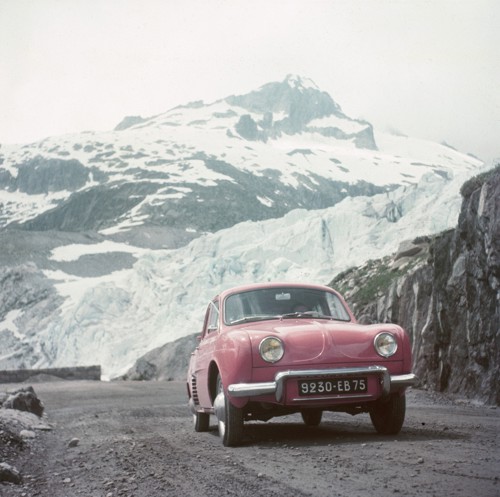
With thanks to Renault Heritage for their time.
With thanks to Renault Heritage for their permission to use the images in this blog.