
A Matter of Estate – The Volvo 1800ES
16 January 2026
The year is 1972, and you are smooth, suave, and sophisticated – a connoisseur of fine wines and Belgian chocolates. Naturally, you desire the ideal car to cut a dash at the golf course - and Volvo has recently launched the P1800ES. This example belongs to Bill Postins.
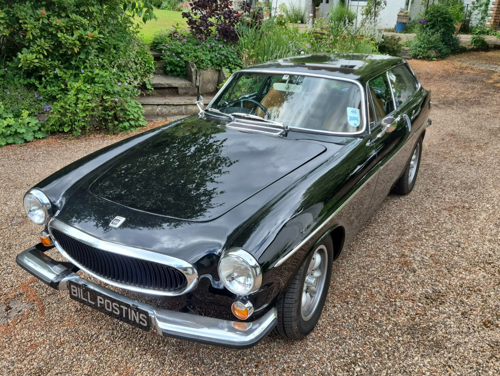
Volvo showcased the original P1800 coupe as early as 1959, and ten years later, it featured Bosch Jetronic fuel injection as the 1800E. By then, plans to rejuvenate the design were underway, and Volvo’s chief engineer, Tor Berthelius, thought a version with room for a set of clubs would have great appeal. From a financial perspective, such a version would not require much in the way of new tooling.
The ‘Beach Car’ proposal by Jan Wilsgaard, Volvo’s Head of Design, was chosen over a rival design proposal by Sergio Coggiola of Turin. The 1800ES made its bow at the 1971 London Motor Show and, surprisingly, given its sleek appearance, it was only a little over an inch longer than the P1800 Coupe. The 1,986cc four-cylinder engine gave a top speed of 115 mph.
At £2,756 in 1972, the 1800ES was not exactly cheap, being over £400 more expensive than a Triumph Stag and its nearest rivals, the Reliant Scimitar GTE, and the Gilbern Invader Estates. All three had 3-litre engines, while an MGB GT was £1,471, a Ford Capri 3000E £1,664, and a Sunbeam Rapier H120 £1,627. Even the BMW 2000 Touring cost less than the Volvo at £2,176, while an Alfa Romeo 2000 GTV would have set you back £2,360.
However, the Volvo possessed a certain social cachet; it is sometimes forgotten that in the early 1970s, ‘foreign cars’ often appealed to suburban sophisticates. In addition, since their UK debut at the 1958 London Motor Show, Volvo had established a firm niche with solicitors and architects, while a certain ITC show gave the earlier P1800 an association with eyebrow-raising adventure. The 1800ES was perfect for the barrister who dreamed of thrilling adventures at Elstree Studios, and who needed space for their golf clubs at the weekend.
The standard equipment of the ES was another selling point: multi-adjustable leather-upholstered front seats, full instrumentation, and J-Type Laycock overdrive on top gear. The estate car bodywork meant greater headroom for the rear seat passengers than in the 1800E; the opening rear window was undeniably stylish, and Volvo thoughtfully provided a pair of under-floor load bay lockers for your golf clubs.
Just in case the potential buyer was carried away by such luxury, and the ES’s good looks, the brochure urged them to “Look at the 1800E and ES as sports car. But think of them as Volvos”. This was a grand tourer with “four-wheel power disc brakes”, and “6 coat finishes outside where most cars have only four”. Motor thought “the ride is good, the cornering power is high, and the handling on the whole very sound”, with “excellent performance” from the 2-litre fuel-injected engine.
By 1972, the 1800ES vastly outsold the 1800E, but Volvo realised it would be uneconomic to modify the design to comply with the USA’s 1974 model year safety standards. Production ceased in June 1973. Today, it is hard to resist the appeal of the 1800ES – a blend of 1950s styling tropes with performance to rival younger designs. The ES was a highly effective method of extending the P1800’s lifespan - and, as Volvo put it, “A Sports Car That Really Hauls”.
With thanks to Bill Postins for their time.
With thanks to Bill Postins for the permission to use the images in this blog.