
A Car From Another World – The Citroën CX Pallas
28 January 2026
It is hard to explain the impact of seeing a Citroën CX Pallas in my home city of Southampton in early 1977. It was not so much a world apart from the red & cream Leyland Atlantean buses, well-used Morris Oxford ‘Farina’ taxis and Bedford CAs piloted by Shane Fenton look-a-like delivery drivers, as apparently hailing from another universe. A CX Pallas, such as this example sold by Karl seemed to glide amongst the ranks of Vauxhall Viva HCs and Hillman Hunters, its driver insulated from every day cares.
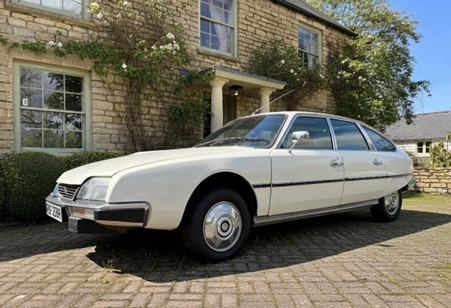
As many readers know, Citroën launched the CX at the 1974 Paris Motor Show with RHD production scheduled for well into the following year. Car magazine believed the CX was “one of the few cars that belongs to the future as it does to 1975”.
The Pallas was the original flagship of the range, with velour upholstery, “deep pile carpet", a “map reading light", two rear courtesy lamps, and “special overall wheel trims”. The proud owner also gained brushed-aluminium finish ashtrays. Perhaps most importantly of all, the Pallas came with ‘Vari-Power’ self-centring power steering, derived from SM.
By 1976, the CX was available with a C-Matic semi-automatic gearbox and a 2.4-litre engine. When Autocar tested the CX2400 they found it required “a lot of familiarization” but was “An excellent car in all but a few respects”. Not that such excellence came cheaply. At £4,706, the CX 2400 Pallas was slightly more expensive than its nearest French rival, the £4,598 Renault 30TS. The latter also offered a fifth door, while CX owners who wanted a hatchback needed to order an after-market conversion from Caruna or Beutler.
However, a Citroën dealer could point out that the Audi 100GLS and the Rover 3500 SD1 were more expensive than the Pallas at £4,850 and £5,130 respectively. The Saab 99GLE, another front-wheel-drive ‘Big Four’, cost £4,953, while the Lancia Gamma Berlina was not officially sold in the UK until 1978.
Meanwhile, for those business executives who valued conventionalism, the Ford Granada Ghia Automatic would have set you back £4,948, the Triumph 2500S £4,405 and the Volvo 244GL £5,430. But the CX did not appeal to motorists who craved tradition – it was for those who appreciated the integrity of its engineering. Not to mention the pride of owning Car of the Year 1975.
And compared with its rivals, a CX Pallas resembled a mobile departure lounge from 2001: A Space Odyssey.
The cabin had such nice touches as blinds for the rear windows, while the seats resembled armchairs. Citroën boasted that the instrument binnacle, with its Cyclops–eye speedometer, was “newly planned for safe driving in modern traffic”.
Above all, a Pallas with the pre-1985 ‘Series 1’ metal bumpers has a certain grace. Motor wrote of the CX “Surely one of the world's most beautiful production cars of all time”. Absolutely.
With thanks to Karl for his time.
With thanks to Karl for the permission to use the images in this blog.