
Meet The Owner – Harry Tansley, Rebel with a Ford Escort Ghia Mk. III
28 January 2026
When he was 16 years old in 2024, Harry Tansley craved teenage kicks, but wild music and clothes did not satisfy him. Instead, he acquired a 1982 Crystal Green Ford Escort 1.6 Ghia Mk. III. Forget Rebel Without a Cause – Harry was now a rebel with a car with “Durham and Crushed velour trimmed seats”. As his father Matt explains:
Harry wanted a classic car, and we found the Escort in Epping. When its first owner turned 94 in 2019, she decided to give up driving, and the second owner did not use the Ghia very much. When I went to see the Ford, Harry was on holiday with his friends in Spain, so I video-called him - fortunately, he loved the Escort!
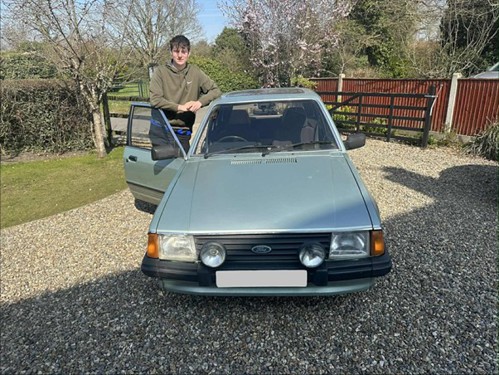
This was highly understandable, as an Escort Mk. III caused quite a stir in its launch on the 3rd of September 1980. There was talk that it was only Ford of Europe’s second front-wheel-drive car, which was not quite the case - the first was the 1962 Taunus P4.
The development costs for ‘Project Erika’ amounted to £500million, while all-independent suspension was a ‘first’ for the Escort. Plus, there was the ‘Aeroback’ hatchback styling, which Ford initially regarded as “too advanced for the family car market”. The sales copy highlighted that it offered “more space and more security than conventional designs”.
An Escort such as Harry’s cost £5,750 in 1982. The same amount could have gained you an XR3, but the two Fords had very different images. If the latter was for posing at traffic lights, the former was ideal for the young executive who aspired to a directorship and the keys to a company Granada 2.8i Ghia X.
The Sunday Telegraph reported the Mk. III “will be competing in a market sector that accounts for about one-third of car sales in Britain”, so the Ghia's “Tilting/sliding screen sunroof with louvred screen” would denote your corporate status to your business colleagues. Not that this was a frivolous fitting, as Ford claimed it provided the driver with “a little solar energy”.
Meanwhile, the Ghia’s “Ford P21 push button radio” and cabin with “wood inserts” bedazzled your neighbours, who were already intrigued by the Mk. III’s bodywork. It is easy to forget just how different the third-generation Escort appeared to anyone used to its ‘three box’ Mk. I and Mk. II predecessors. The Aeroback styling made it look different to any rival, from the Vauxhall Astra and the VW Golf to the Fiat Strada, the Talbot Horizon and the Citroën GSA.
In 1982, the Escort Mk. III overtook the Ford Cortina Mk. V to become the UK’s bestselling car, and today, any five-door Ghia is so rare as to turn heads. Harry passed his driving test last year, and he greatly enjoys motoring in a car built 25 years before his birth. His Escort is the equivalent of someone of my vintage (born 1969) buying a 1944 Army-surplus Hillman Minx at 16.
Almost every detail of Harry’s Ghia reflects a lost world, when its five-speed gearbox was not a guaranteed fitting on a mass-produced car and when a car radio was a luxury in a small hatchback. The launch brochure even proudly announced that the L, GL, Ghia and XR3 had a heated rear window as standard.
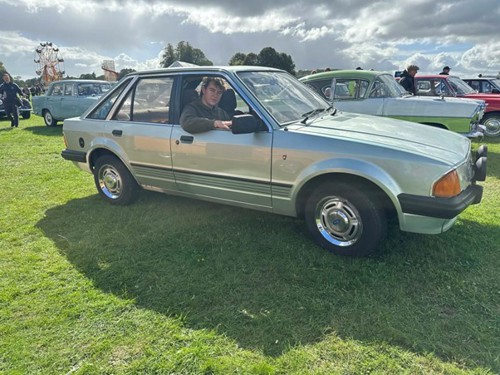
As with many a fine vehicle, the Escort has faced its fair share of mechanical challenges, but Harry enjoys working on it, and keeping the Ghia’s condition as original as possible. It virtually goes without saying that enthusiasts of his age represent the future of classic cars.
Even if the fact that the Ford Escort Mk. III fascinated my ten-year-old self at the 1980 Motor Show, now makes me feel very old...
With thanks to Harry and Matt Tansley for their time.
With thanks to Harry and Matt Tansley for their permission to use the images in this blog.