
“Every journey is an experience” - A 1956 Opel Kapitän
13 July 2026
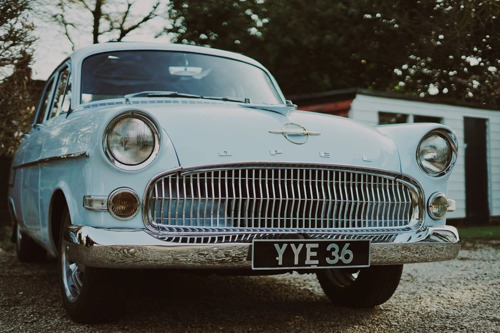
There is a select group of cars that the average UK enthusiast is more likely to see on screen than in the metal. Andreas Englezos’ 1956 Opel Kapitän is the sort of vehicle in the street scenes of The Quiller Memorandum or Funeral in Berlin. Andreas’ Opel was originally ordered by a member of the RAF serving in Germany and was privately imported to this country in 1960.
Perhaps the best way to describe the Kapitän is the German equivalent of the E-Series Vauxhall Cresta, although the Opel is around a foot longer than its Luton counterpart. Both hail from the General Motors empire, and both aimed to provide scaled-down Americana to prosperous European customers.
The first post-war Kapitän dated from 1948 and was Germany’s first post-war six-cylinder car. Power was from a 2.5-litre unit shared with the Blitz lorry. The Allied Powers had previously banned the production of German cars with engines larger than 1.5 litres, delaying the introduction of the latest Opel.
The first sales were to Allied Authorities – the US Army was a major customer - and private buyers could not acquire a Kapitän until 1949. By 1951, Opel was Germany’s second-largest vehicle manufacturer after Volkswagen. In 1953, they introduced completely new bodywork for the Kapitän, with slight overtones of the 1952 Chevrolet Styline.
The Mercedes-Benz 180 ‘Ponton’ may have possessed more of a bourgeois image, and the Hansa 1800 had a certain elegance, but the Kapitän offered six-cylinder power and a sense of trans-Atlantic verve. A top speed of just over 85 mph meant that it was suited to the Autobahn, and in 1954, the Kapitän’s home market price of 9,500 DM was equivalent to £840 - a bargain for such an imposing vehicle.
Opel claimed that a Kapitän accounted for every second car in its market sector in the first half of 1954. They also stated that "Every journey is an experience" in a Kapitän, while the engine was “beyond all criticism. You can trust it blindly. There is none that has proven itself better”.
Andrea’s Opel has the vertically barred grille and the vestigial tailfins of the post-August 1955 versions: the Kapitän also gained a slightly more powerful engine. Motor-Rundschau magazine thought:
The Kapitän is not only one of the most highly regarded and largest ‘Europeans’ with the best use of interior space, but is also very fast and spirited thanks to the reliable and mature 2.5-litre six-cylinder OHV short-stroke engine and is roadworthy for a car of the usual design (with engine mounted far forward and rigid rear axle).
Meanwhile, those motorists with a taste for the good life could order the L version with reversing lamps, windscreen washers, reclining front seats and a headlight flasher as standard. There was also a crown on the bonnet to impress other road users. Andreas also points out that:
This model had an option for a clutchless manual, and those versions had an overdrive gear - borrowed from the Chevy, and called the Hydramatic. It was fitted with a centrifugal clutch and a vacuum operated clutch linked to the throttle/carburettor. They are very rare and very sought after because the engine is more than capable of handling an overdrive or higher gear.
On the 9th of November 1956, Opel celebrated becoming the first German manufacturer to build two million cars with a special Kapitän trimmed with 24-carat gold. The replacement P2.6 debuted in the summer of 1959, and its predecessor is now a sought-after classic in Germany. Opel modestly claimed that the Kapitän was “A car that belongs to the world”, but official UK sales of the marque would not resume until 1967.
I look forward to writing more about Andreas’ Kapitän. It really is the post-war ‘Wirtschaftswunder’ Economic Miracle on four wheels; a car to speed past VW Beetles and two-stroke DKWs.
With thanks to Andreas Englezos for his time
With thanks to Andreas Englezos for the permission to use the images in this blog.