
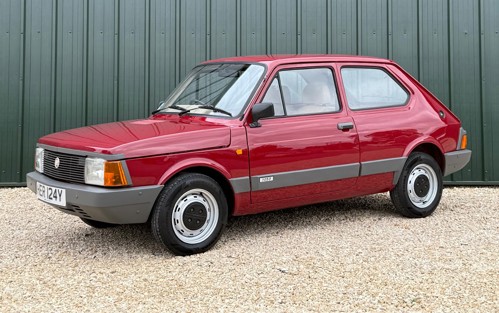
Meet the owners – Maia and Michael Egan and their Fiat 127 1050 Comfort
13 July 2026
Debates about ‘What was the first Hatchback?’ are almost as tedious as an episode of Crossroads circa 1977. If your criteria are front-wheel-drive and a tailgate, then the Citroën Traction Avant Commerciale might have a claim to the title, but if you also include a transversely mounted engine, then the Autobianchi Primula might fit the bill.
Meanwhile, others might cite the Fiat 127, which debuted in April 1971, and the Renault 5, which made its bow in early 1972. The Fiat was initially available only in two-door guise, with a hatchback only becoming available a year later, while the Renault was sold in three-door form from the outset, but had a ‘North-South’ engine layout.
At this point, it is best to leave the debaters and watch the Crossroads’ flexible scenery, as the 127 is a fascinating vehicle. Michael and Maia Egan’s 1983-model 1050 Comfort is a last-of-the-line version. The fact that the bodywork looks a decade younger than its real age is a testament to its designer Pio Manzù, who tragically died in 1969 in a car crash aged only 30.
Fiat devised the 127 as the heir to the rear-engine 850, which they introduced in 1964. The company used their Autobianchi subsidiary to evaluate FWD with the Primula, and the experiment was successful enough to result in the 1969 128, the first Fiat-badged front-wheel-drive product. The 127 was their next, and in 1974 sales exceeded one million. By the mid-1970s, the 127 was Europe’s best-selling car.
The 127 received a Series 2 facelift in 1977, followed by a further upgrade as the Series 3 in November 1981, when sales had reached five million. By early 1983, a Comfort in three-door form was £3,519. Incredibly, Fiat still offered a two-door 900 version for £3,270, presumably for those motorists who regarded hatchbacks as dangerously radical, and The Archers as cutting edge.
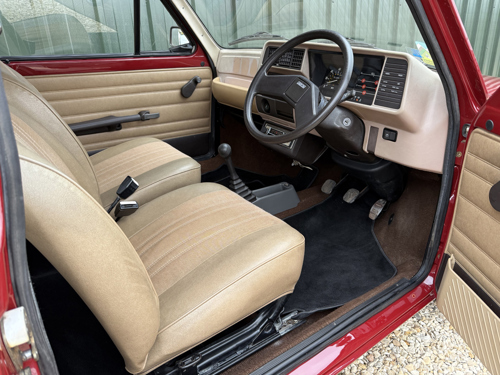
Seasoned Fiat-watchers knew that the ‘Comfort’ badge denoted “not very much equipment”, but the brochure assured potential buyers that its dashboard “would do justice to a far more expensive car”. There was also reclining front seats with head restraints and a cigarette lighter, although a clock, a passenger vanity mirror and a split rear seat were the province of the more opulent 127 Super.
The Comfort also represented somewhat of a bargain, when the Ford Fiesta Popular Plus was £3,743 and the Austin Metro ‘Base’ was £3,599. There was also the Peugeot 104 GL for £3,645, the Renault 5TL at £3,794, and the Talbot Samba LS for £3,595. Other choices included the Volkswagen Polo C priced at £3,998, and the Citroën Visa L at £3,599, but no true Fiat enthusiast would accept any substitute.
UK imports of the 127 ended with the start of Fiat Uno sales in June 1983, and the Egans’ comfort is one of the very few surviving examples. You can discover more of its adventures online -https://www.youtube.com/@OldCarsNewVan. Michael finds the 127 to be “Surprisingly go-kart like - like an original Mini! It is best driven enthusiastically, but the gear change is a bit sloppy, and the brakes need a good prod as they're non-servo!!”.
And while the 127 may not have been the first ‘hatchback’, it is certainly one of the most important.
With thanks to Maia and Michael Egan for his time.
With thanks to Maia and Michael Egan for the permission to use the images in this blog.