
“Extra-handsome fittings for maximum pleasure” - the Volkswagen T1 Samba
14 July 2026
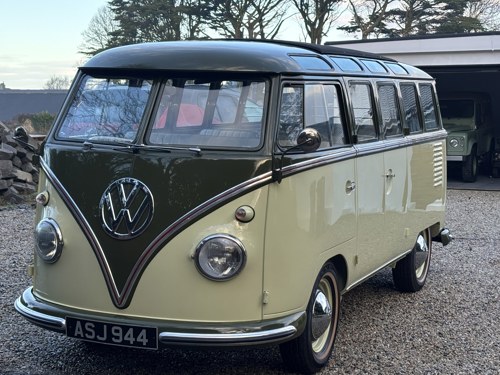
That is how one English-language brochure described the Samba, one of the key Volkswagens of the 1950s and 1960s. This Palm Green and Sand Green example - https://www.carandclassic.com/l/C2002694 not only has a diplomatic background but also unique bodywork.
The story begins in 1946 when the Dutch businessman Ben Pon visited Wolfsburg to negotiate Volkswagen sales in the Netherlands. His Automobielhandel became the first dealership outside of Germany to market the Beetle, while Pon was intrigued by the plant’s ‘Plattewagen’, an improvised motorised trolley with Kubelwagen running gear. On the 23rd April 1947, he sketched an idea for a Volkswagen light commercial vehicle with a Beetle engine to the British Military authorities.
Colonel Radclyffe thought the factory lacked production capacity, but Major Ivan Hirst, who had guided Volkswagen’s post-war revival, thought Pon’s idea had merit and told him it would be further developed if matters changed. Shortly after Heinrich Nordhoff became the civilian Director General in 1948, he commissioned Alfred Haesener, the head of development, to develop Pons’ ideas.
The Volkswagen van would employ unitary construction, with subframes reinforced by longitudinal rails and cross-members between the front and rear axles. Nordhoff believed its layout far superior to the cab-above-the-engine format, which he thought resulted in "such horrendous handling that we never even considered it”. There was no rear window, and access to the load bay was via side doors. Nordhoff chose the ‘V’ front over a flat-fronted alternative.
VW displayed a hand-built ‘Type 2’ to the press on the 12th of November 1949, and that year Autocar announced that Volkswagen would build “a 15 cwt van, a station wagon and an eight seater bus on a new structure evolved by Dr . Haesner”. Production began on the 8th of March 1950. The top speed was 47 mph, and your local Volkswagen dealer might tell you that it could be ordered in any colour you desired so long as it was Taubenblau or in primer.
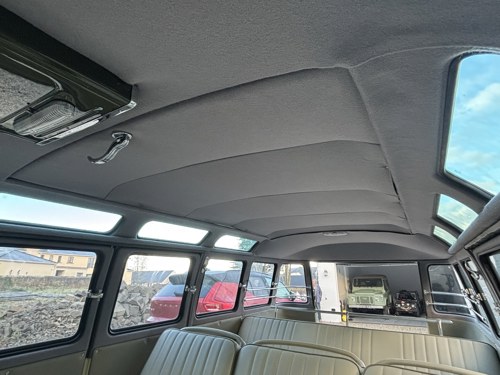
And the 1951 Frankfurt Motor Show saw the launch of a De Luxe eight-seater version with triple-tone paintwork (soon changed to duotone), a more elaborate fascia including a clock, 23 windows, including eight skylights, and even a folding Golde sunroof. Passengers entered through double doors on the right; access to the rear seat was via folding a backrest on the middle row. The price was 9,250 DM – 3,000DM more than the standard model, but who could put a price on such style? If you were feeling extravagant, you could specify an optional Auto-Super radio.
VW initially called their ultimate T1 the “Kleinbus Sonderausführung” - “Small Bus, Special Version” - and the Micro Bus De Luxe in English-speaking markets. By 1954, the Dutch price list referred to them as the Samba, although the name’s origins is shrouded in mystery.
The previous year. VW increased the Type 2’s engine capacity from 1,113cc to 1,192cc, and the transmission was now fitted with synchromesh on the upper three ratios. RHD models were only to special order until 1954, when full production began. UK marketing began on the 23rd of January: the Pick-Up was £648 1s 3d, and the van with doors on one side was £668 1s 3d, with a double set of doors costing another £7. The Kombi was £845 9s 2d, the standard Micro Bus £919 2s 6d, and the Microbus De Luxe £1,198 4s 2d – or more than the price of a Ford Zephyr-Zodiac.
Commercial Motor thought “Newcomer Sets High Standard”. However, two years later, an irate ‘Rover Driver’ wrote to Autocar to complain about the star vehicle in The Quatermass X-Periment. “The Volkswagen Microbus was obviously brand new, and if this film is shown abroad, it could have a bad effect on our car exports’.
The Type 2 gained an extensive facelift in March of 1955, with a hatchback and a smaller engine hatch in place of the earlier ‘Barn Door’. There was now a peak over the windshield incorporating air vents “capable of renewing the total volume of air once every minute”, according to Volkswagen. There was also safety glass instead of Plexiglas on the rear corner windows. By then, the UK price was £1,351 7s, when a Bedford CA ‘Utilabrake’ was £545, but Volkswagen enthusiasts believed the T1 was worth every additional shilling, even if it did cost more than two Austin A30s.
By August 1963. Volkswagen replaced the original ‘23-window’ Samba with the ‘21-window’ version; a wider tailgate eliminated the glasswork at the rear. Production ended in 1967 with the introduction of the ‘T2’ Type 2, and this example left Wolfsburg in 1961. The Swiss Embassy in Sweden commissioned it with double-sided opening doors – Sweden drove on the left until 1967 – and this Samba is believed to be the sole example in the world with this bodywork.
The Samba is one of the key vehicles of the German Wirtschaftswunder ‘Economic Miracle’; proof that style and practicality need not be mutually opposed. Plus, who could resist opening the Golde sliding roof, which “freely admits the bracing air and sun into the interior”.
With thanks to Anthony for his time.
With thanks to Anthony or the permission to use the images in this blog.