
“The perfect marriage of unique style and motoring luxury” - The Rover V8-S
14 July 2026
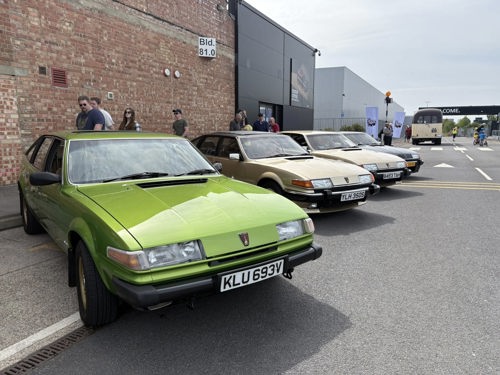
One of the many delights of Drive It Day Cowley 2026 was seeing a car that my nine-year-old self once craved. In 1979 a Rover SD1 V8-S in Triton Green was so far removed from the other vehicles in my Hampshire village as to be almost surreal. Period dramas set in the late 1970s often overlook just how many older cars were then still in regular use, and the less-than-mean streets of Swanwick were home to Ford Cortina Mk. I ‘Areoflows’, FB-Series Vauxhall Victors and Wolseley 1500s.
Add the occasional very well-used Bedford CA, and Ford Consul Classic with an offside tailfin about to fall off, and it is easy to appreciate how exotic a V8-S appeared. It was not only the gold alloy wheels, the headlamp washers & wipers, a windscreen with a green ‘graduated tint’, a sliding roof, and the headrests fore and aft, but also the air-conditioning. This last-named was a rare fitting in the SD1’s market setting, and helped to justify British Leyland’s claim that the V8-S represented “The difference between the best and the rest”.
BL used the V8-S as a testbed for the SU-Butec refrigeration system in their North American SD1s, as the Rover marque was to return to the USA after a long absence. It was destined to have a short production run, as its 3500 Vanden Plas replacement was scheduled for September 1980. Leyland planned to make 140 V8-S per week, but only 1,040 examples departed the factory.
The role of the home market V8-S was to tempt managing directors and QCs away from Jaguar, BMW, and Mercedes-Benz. In 1980 it cost £10,699.22 with five-speed manual transmission, or £10,929.22 with an automatic gearbox – over £2,000 more than a standard 3500. The V8-S was also over £1,200 more expensive than a BMW 528i.
However, your friendly local dealer could point out that the V8-S was over £800 cheaper than a Mercedes-Benz 280E W123 and was over £1,000 less than an Audi 200T. In terms of performance, the additional trim of the V8-S meant a 1½ CWT weight penalty over the standard 3500, but it could still achieve of 123 mph, with 0 to 60 in 9.7 seconds. Plus, for those not enamoured with Triton Green, there were the options of Midas Gold, Persian or Aqua Blue paint finishes.
Nearly 46 years after the demise of the V8-S, Drive It Day 2026 was an opportunity to revel in its sheer exuberance. The subsequent Vanden Plas versions were more low-key, but the Rover on display at Cowley revelled in conspicuous consumption, from its gold alloy wheels to its plush carpeting. One intriguing detail was its traditional ‘Viking’ bonnet badge, as the ‘Skeleton’ logo on earlier SD1s had attracted some criticism from Rover die-hards.
And, perhaps most importantly, the V8-S was a reminder of David Bache’s achievements when he devised the SD1. In 1979 there was no other RWD five-door fastback with overtones of a Ferrari Daytona. Or, as Rover boasted: “We set out to create an exclusive member of the Rover stable that would offer you the perfect marriage of unique style and motoring luxury”.
Personally, I think that my nine-year-old self had excellent taste in cars...
With Thanks to Gavin Bushby for his picture.