
The Remarkable Citroën GS Birotor
14 July 2026
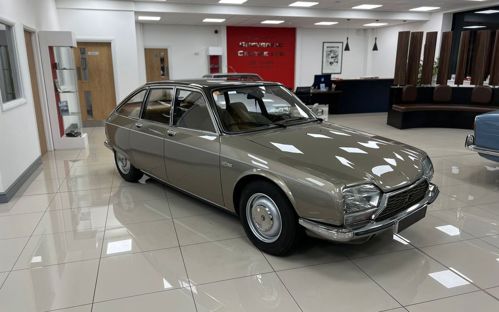
Some time ago we wrote about how, at the 1973 Frankfurt Motor Show, Citroën unveiled a version of the GS unlike any other car in its class, and quite possibly in the world. The standard version was a remarkable vehicle in its own right, becoming Car of the Year 1971, but the Birotor displayed by The Chevronic Centre - https://www.chevronics.co.uk/- was powered by a Felix Wankel-designed twin-rotor engine. Today, there is believed to be a mere two in the UK.
The narrative starts in 1964, six years before the launch of the GS. Citroën and NSU formed a joint venture, Comotor - ‘Compagnie Européenne de Construction de Moteurs Automobiles’ - and three years later, a factory in Germany began producing rotary engines. The collaboration ended in 1969 when Volkswagen acquired NSU, but Citroën continued with the project. One advantage of a rotary unit was that it offered high power output from a relatively small capacity, thereby avoiding tax penalties from the French government applied to a large engine car.
Naturally, Citroën needed to evaluate this new engine, and so they built 267 Ami M35 Coupes powered by a single-rotor unit – the company originally planned to make 500. The performance figures were 0-60 in 18 seconds and a 90-mph top speed – impressive in comparison with the standard Ami 8. Citroën sold the M35s to “consumer-testers” who agreed to drive them for at least 30,000 km per year, to pay for fuel, and to provide Citroën with regular performance reports. In return, the owners received free technical assistance and the company’s promise to repurchase the used Amis at a reasonable price two years later.
This proved an expensive process for Citroën - the M35 was said to have been made at a loss – but they decided to build the Birotor, based on the flagship GS Pallas. The company’s experiment with the M35 revealed that a single-rotor engine was too small for the GS, while the CX, due for launch in 1974, would better suit a triple-rotor unit. The Birotor would have a twin-rotor engine of the same dimensions as the M35, and as it was water-cooled, this meant a new radiator and a transverse layout.
The Birotor shared only doors and roof with the standard GS, and the floorpan, exhaust system, and fuel tank were also modified. It also lacked the GS’s in-board brakes due to a lack of space, and there were flared front wheelarches for the wider track and larger tyres. The transmission was the three-speed semi-automatic C-Matic box with a torque converter. The proud Birotor owner further benefited from high-backed front seats and Jaeger instruments, while extras included a sunroof, tinted glass, a Blaupunkt radio, and rear seat belts.
The timing of the Birotor’s launch was crucial, as the company wanted it to debut before they announced the CX in 1974. There was considerable interest in the first French production car equipped with a Wankel engine, and Citroën planned sales to begin in the spring of 1974. Dealers could highlight the rotary engine’s smoothness, how it would not require oil changes, and how the twin 497.5cc rotary units gave a performance equivalent to a 2-litre car, with a 109-mph top speed. Furthermore, the Birotor’s vinyl roof and metallic bronze paint finish would add distinction to any driveway and induce envy in any Renault 12 Gordini and Peugeot 304 owners.
Unfortunately, the Birotor was also expensive at 24,952 Francs, when a DSuper5 was 22,600 Francs and a standard GS Pallas was 20,080 Francs. A further problem was the high fuel consumption in a car with the misfortune to debut only weeks before the 1973 OPEC Fuel Crisis. The price of crude oil rose by 68%, and a car with an 18-mpg petrol consumption now looked very unappealing to many drivers. To make matters worse for Citroën, the Birotor also suffered from exhaust emissions, oil consumption, and unreliability.
Citroën hoped to sell the GS Birotor in the UK for £2,000 in 1974, but as the year progressed, this appeared increasingly unlikely. By the middle of that year, the company was in a parlous state, with over 120,000 cars in stock and potential losses of 1,000 million francs at the end of 1974. The French government arranged discussions with possible buyers, and by December 1974, Peugeot took a 35% share in Citroën. It would not require Nostradamus-like abilities to predict an imminent complete takeover and the demise of their slower-selling models. Birotor production ended in March 1975 after just 847 units, while plans for the triple-rotor CX were never to be realised.
Citroën tried to repurchase all models to avoid warranty claims and maintain a supply of spare parts. They offered the owners a substantial rebate on a new CX and destroyed many of the re-acquired Birotors, using hydraulic punching machines to render the Wankel engines unusable. Some others were re-engineered as the standard GS 1220 (and classed as a “new” car), or given to employees. Possibly 100 GS Birotors escaped scrappage, although obtaining spares could prove a nightmare. Citroën obtained a special government dispensation to exempt them from keeping any Birotor parts in stock.
All of which makes any surviving GS Birotor a car of almost endless fascination. The production run may have been limited; the market may have been niche – but the Birtor really does illustrate the sheer scope of Citroën's ambition.
With thanks to https://www.chevronics.co.uk/ for their time.
With thanks to https://www.chevronics.co.uk/ for the permission to use the images in this blog.