
The Ideal Summer Car – The Fiat 500 Jolly
22 July 2026
A Fiat 500 Jolly is probably not the idea car for the office commute. The seats are wicker, there are no doors, let alone side windows, and the creature comforts are limited. As for weather protection, this is provided by a folding canvas awning. But the Jolly was intended for the Jet Set to stow aboard their yachts and use as onshore transport in St. Tropez, Capri, Monaco, or Porto Cervo.
In 1954, Carrozzeria Ghia devised a Renault 4CV ‘Beach Car’. Three years later, Gianni Agnelli, the CEO of Fiat, needed four-wheeled transport light enough to be loaded and carried on his yacht Agneta, with sufficient power for road use. The Nuova 500, launched on the 4th of July 1957, was the idea base for such a vehicle
Ghia removed the doors and roof and installed the body with nautical-style grab rails. The wicker seats were water-resistant – essential for a car designed for beach use – and the floor had drain holes. The coachbuilder reinforced the bodywork to compensate for the lack of a roof. The Jolly’s engine was the standard four-stroke air-cooled twin-cylinder 479cc unit, giving a top speed of around 53 mph – more than sufficient for a trip to the golf course.
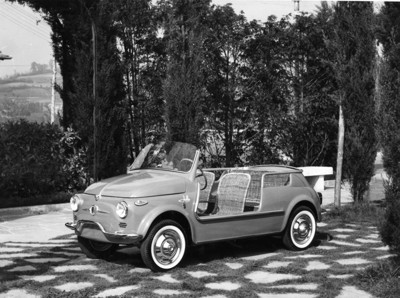
A 500 Jolly prototype starred at the 1957 Turin Motor Show, with the larger and more powerful 600 Jolly debuting in 1958. The colour choices for “La Spiaggina,” as it was known in Italy, were coral, pink, sky blue, white, or yellow, while its price was virtually double that of the standard model. This was a 500 for Aristotle Onassis, Yul Brynner, Henry Ford II, Princess Grace of Monaco, Elvis Presley, John Wayne, and even President Tito of the former Yugoslavia. Fiat gave a Jolly to President Lyndon B. Johnson, who used it as a golf buggy.
As for export sales, Jollys were marketed in the USA between 1958 and 1962, where they appeared in 7-Up advertisements. In 1959, Road and Track magazine reported that their test Jolly attracted crowds, who were amazed that it cost nearly $2,000 – a considerable sum at that time.
Sadly, the Jolly was never a part of Fiat GB’s line-up, as our climate might have proved a sales deterrent. This is a shame, as a Jolly would have caused a sensation in Swanage or Weymouth, darting between holidaymakers’ Ford Consuls and Vauxhall Victors, and causing amazement with Rigsby-style boarding house owners.
Ghia ended Jolly production in 1966 after circa 400 units, and this example is a reminder of the coachbuilder’s foresight. The 500 Jolly anticipated the Mini Moke, the Renault 4 Plein Air, the Citroën Mehari, the SEAT 127 Samba, and almost every other Beach Car.
Not to mention that it really is La Dolce Vita on Wheels.
With thanks to Stellantis Media for permission to use the images in this blog.