
THE ROVER SDI AT 50
22 July 2026
“I was first involved in the club as a member in 2004, and I own three SD1s – a 1978 2300, a 1980 3500 (North American Specification), and a 1986 3500 Vitesse. Generally, there is affection for the SD1, the majority of people who remember them either their dad or grandad having one - and there are also memories of police usage!”
Chris Powell is the Historian of the Rover SD1 Club. They plan to display a fleet of 50 at the BMC/BL Day on the 12th of July at the British Motor Museum, to celebrate the model’s half-century. When Rover unveiled the 3500 SD1 at Château Impney on the 30th of June 1976, it more than fulfilled the aims of the Head of Design, David Bache - “The word ‘elegant’ describes the styling philosophy behind the new Rover”.
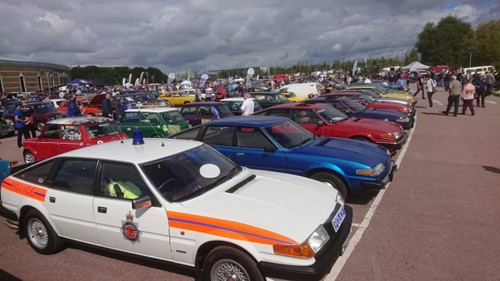
A few months later, this writer encountered his first SD1 in the metal and was utterly mesmerised, for it resembled no other previous Rover. In my experience, the marque fell into the following three categories:
The P6B – as used by Hampshire Constabulary.
The P5B saloon– always appearing on ITN or BBC News outside of No. 10 Downing Street.
The P4 – usually driven by gentlemen who resembled James Robertson Justice or Robert Morley.
Instead, here was a five-door fastback that seemed a world apart from a Ford Granda Ghia, a Jaguar XJ6 3.4 Series II or a Triumph 2500S. To my younger self, that Rover appeared a vision of the future, down to an instrument display that resembled a block of Lego. I think I was aware of the SD1 before encountering that Rover in the Hampshire village of Swanwick – my father took Car magazine and their April 1976 edition ran a major article on the new 3500 – but nothing prepared me for that first encounter.
British Leyland promised the discerning buyer “A car with distinctive styling, versatility for its dual role in your business and social affairs, comfort - luxury even”. The SD1 had Ferrari 365GTB/4 Daytona overtones, defeated the Audi 100 C2 to become Car of the Year 1977 and was awarded the Don Safety Trophy.
At £4,750 in five-speed transmission guise, the new Rover was cheaper than the £5,186 Mercedes-Benz 230 W123, the £5,306 Peugeot 604, and the £6.086 BMW 525 E12. A Volvo 264GL cost a vast £6,481, and a Ford Granada 3.0 Ghia Automatic was £4,948. As for hatchback competitors, the Renault 30TS was only £4,598 and highly respected by the motoring press, but the typical Rover buyer probably favored rear-wheel drive.
For that reason, they also ruled out the Audi 100 GLS at £4,850 or the Citroën CX Pallas for £4,706.
Perhaps the greatest challenge facing Rover dealers was not the SD1’s rivals, but the corporate image of British Leyland. The concern had been nationalised in 1975; newspapers carried accounts of their industrial disputes, and Car of April 1976 described the SD1 as “Rover’s Nick of Time Machine”. Shortly before its launch, Derek Whittaker, the MD of Leyland Cars, told the press that BL needed the “Dunkirk Spirit”. The fact that British Leyland felt the need to commission the infamous internal training film, The Quality Connection, speaks volumes about its self-image in the late 1970s.
But the SD1 transcended such issues, for it is one of the great post-war Rovers. And seeing the 50 gathered at the British Motor Museum will remind so many visitors of a certain age of their first encounter with a Rover SD1.
With thanks to Chris Powell for his time.
With thanks to Chris Powell for the permission to use the images in this blog.