
Meet the owner – James Macbeth and his Citroen Visa Club
23 July 2026
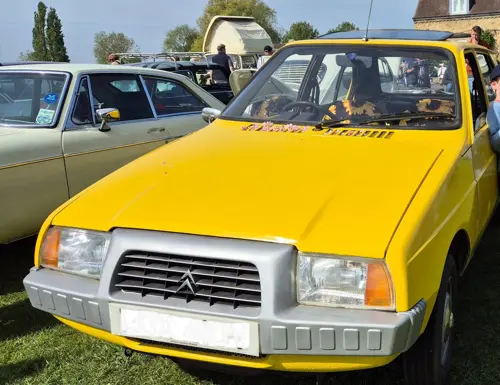
James is the proud owner of one of the most distinctive cars of the 1970s – a first-generation Visa Club. Here are 30 facts about one of the world’s most fascinating Citroëns:
- The Visa’s origins date from the early 1970s when Citröen collaborated with Fiat on ‘Projet Y’.
- Y was to be a five-door Fiat 127-based hatchback.
- The design was finalised by 1972, but Fiat’s 1973 withdrawal from the project meant that Citroën re-developed Y as the ‘TA’, with 2CV and GS engines.
- By 1974, Peugeot took control of Citroën, which meant TA was cancelled in favour of ‘Projet VD’ (“Voiture Diminué”), based on the 104’s floorpan.
- The TA eventually became the Romanian-built Citroën Oltcit Club, which was exported as the Axel.
- Robert Opron created the Visa’s look, and Michel Harmand designed the fascia.
- To introduce the Visa to the press, in August 1978, Citroën arranged for 430 journalists to travel from France to Kallithea on the island of Rhodes.
- The Visa made its public bow on the 5th of October 1978 at the Paris Salon.
- Citroën intended the Visa to be the heir to the Ami 8, which ceased production in 1979.
- The Spécial and the Club versions were powered by the 2CV’s longitudinal-mounted air-cooled 652cc unit.
- The flagship Super shared the transversely mounted ‘Douvrin’ 1,124cc unit with the Peugeot 104 and the Renault 14.
- The suspension was via front McPherson struts and rear coil springs.
- The combined front bumper and grille was a ‘first’ for Citroën.
- The Club boasted hubcaps, reclining front seats, and a clock as standard, while the Super had more luxurious upholstery, side protection strips, carpets, and a rear anti-roll bar.
- Electronic ignition was a genuine talking point for a small car in 1978.
- Your colour choices were Mimosa Yellow, Nevada Beige, Myosotis Blue, Geranium Red, Nacre Grey, and Reinette Green.
- All versions featured a “PRN satellite” - P for “Pluie” (rain), R for “Route” (road), and N for “Nuit” (night) - containing lights and wiper switches beside the instruments.
- The idea behind PRN was that the driver could operate the switches without their hands leaving the steering wheel.
- French prices ranged from 22,660F for the Special to 25,800F for the Super.
- The launch slogan was "Ça, c'est une auto” - “Now that’s a car”.
- UK sales began in 1979.
- Autocar compared the Visa’s styling to “the work of a precocious willful child curbed carefully by an intelligent, sensible, mother”.
- Car wrote: “This is the time to come clean. We are among those who love the Citroën Visa’s styling”.
- The Observer thought the Visa was “an emientlly sensible car for most purposes”.
- The Telegraph regarded the Visa as “the sort of car that gladdens the heart of a motoring writer”.
- Citroën GB proudly claimed the Visa was “an example of what can be achieved by a design office, which is determined to express the true personality of its marque while using the full resources of a large industrial group”.
- The coachbuilder Heuliez devised the facelifted Visa II with a new grille and rear lights.
- Citroën launched the Visa II in March 1981, and it proved so popular that sales increased by 50% between 1980 and 1982.
- By 1982, the Visa was Citroën’s best-selling car.
- Visa production ended in September 1988 after 1,254,390 units.
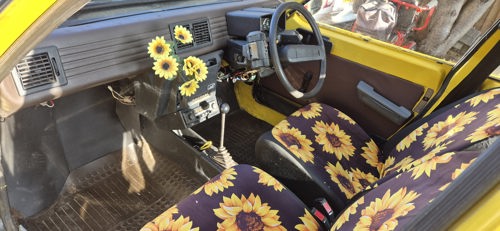
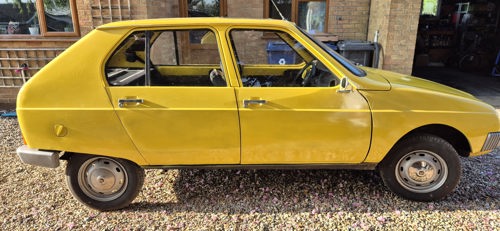
With thanks to James MacBeth for his time.
With thanks to James MacBeth for permission to use the images in this blog.