
Meet the owner – Tim Rycroft and his Mercedes-Benz 250
31 July 2026
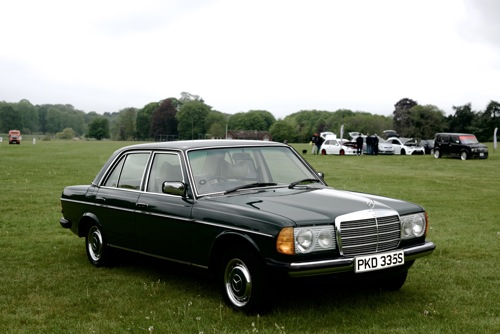
I first came across the car over 20 years ago at a Mercedes-Benz Club event. It is a very rare car, both because it’s from the first series of the W123 (most of those still on the roads post-date the 1982 facelift) but also because the 250 petrol option accounted for only 4% of all the W123s made. It has been owned by several of the Club’s leading W123 enthusiasts. I bought it from a 123 specialist in North Yorkshire in 2016 who was already looking after my other classic Mercs. He had bought it because it was the precise same specification as a company car he had owned many years earlier.
Tim Rycroft, the Chair of the Mercedes-Benz Club UK, is the proud owner of a 1978 W123 250, a car that was a very exclusive sight on British roads when it was new. At £8,395, the 250 was over £1,200 more expensive than a Rover 3500 SD1, and over £1,000 more than a Ford Granada 2.8i Ghia. An Audi 100 GL-5E was a mere £6,020, and a BMW 525 was £7,490.
The well-heeled buyer may also have considered a Volvo 264 GLE for £7,958, an Opel Commodore GS/E for £7,455, or a Peugeot 604 SL for £6,611. But a Mercedes-Benz enthusiast would argue that there was no substitute for the W123’s integrity of engineering. Regardless of its position in the line-up, it was a car that valued quality over exterior decorations and gimmicks. The W123 even had a provision for airbags; remarkable in a 1976 car.
Daimler-Benz began planning the eventual heir to the W114/W115 in 1968, the year of its launch. They unveiled the W123 on the 29th of January 1976, and D-B's Head of Development, Dr. Hans Scherenberg, told the press: “I am delighted to be able to present to you today a new model series that will be the mainstay of our passenger car range for the next few years”. A production run of 2.7 million vehicles proved him right.
By the end of 1976, the W123’s three-year waiting list created a black market, with motorists paying an additional 5,000 DM for early delivery. It was not unknown for M-B employees willing to sell their nearly new W123s to be approached by dealers with suitcases of cash outside the factory gates. The W114/W115 remained available alongside the W123 for eleven months, partially because supplies of its replacement were initially limited. By 1980, the W123 displaced the VW Golf as the former West Germany’s best-selling car.
The W123 had, according to the launch press release, “proven components”, although the 250’s M123 six-cylinder SOHC unit did represent a new engineering development. Tim finds it very different from the 280:
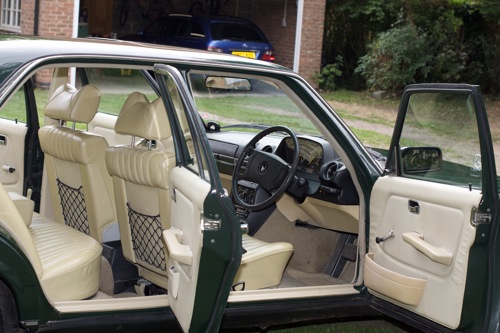
The 250 develops 129bhp compared to a mighty 185bhp in the later 280Es. The 280 is a twin-cam with four valves per cylinder; the 250 is single cam and two valves. The 280E is renowned for sounding busy or even tappety when making progress. The 250 is best enjoyed as a leisurely and unstressed cruiser. Beyond the engine differences, the 250 came with a (even by Mercedes’ standards) spartan basic specification, whereas the 280Es as the range-topper, came, for example, with standard wood trim on the dashboard and superior headlights.
A 250 owner had to pay extra for electric windows and automatic transmission, but they had the pleasure of driving a Mercedes-Benz, and that was above mere deutschmarks or pounds. The W123 made its UK debut at the 1976 London Motor Show. That year, sales of new Mercedes-Benz cars amounted to 5,250, and the W123 would be instrumental in their ambitious plans for the British market. The concessionaire aimed to sell 8,000 cars in 1977 and 10,000 by 1980. The buyer for a new W123 saloon might be a Peter Bowles or Diana Rigg-style barrister with a Knightsbridge address, and an amused disdain for Granada Ghias.
Production of the W123 saloon ended in late 1985, and the coupes and the estate cars in 1986. Today, Tim finds the typical reaction to his 250 is that:
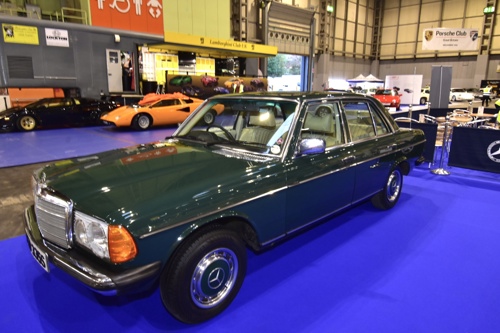
People most often comment on the colour - even today, dark green is a rare sight. I also get lots of ‘My Dad had one of these’ or “I was driven to school in one of these’. With the first 123s now fifty years old, it is not a car that people see on the roads very often, and it does attract a lot of love and attention. The chrome wheel embellishers are also frequently remarked upon.
And Tim’s W123 embodies Mercedes-Benz's promise of “a singular new achievement”.
With thanks to Tim Rycroft of https://mercedes-benz-club.co.uk/ for his time.
With thanks to Tim Rycroft for the permission to use the images in this blog.