
“An entirely new concept of high speed motoring” - The Jaguar E-Type at 65
07 July 2026
On the 15th of March 1961, Sir William Lyons unveiled Jaguar’s latest sports car to a select audience at the Geneva Motor Show. This silver Roadster from DK Engineering is a reminder, if one were needed, of how different the E-Type appeared to motorists in 1961 – not just in comparison to the outgoing XK150, but to virtually every other car on the road. Imagine that you were driving along the A27 in your Ford Prefect 107E and this vision appeared in your rear-view mirror. To quote Jaguar: “The ‘E’ Туре car is not just another Sports car in the conventional sense of the word. It is an entirely new concept of high speed motoring”.
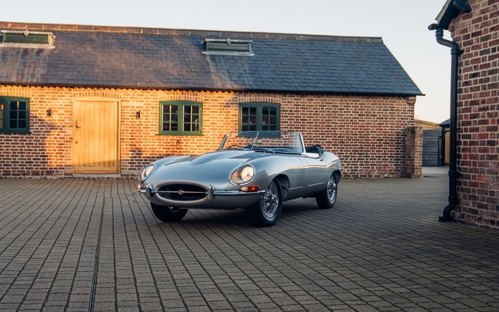
The great Malcolm Sayer began work on the E-Type in 1956, a year before the introduction of the XK150. The company initially believed they would produce a total of 250 E-Types, while the launch sales copy stated that the monocoque construction “stems directly from Jaguar sport-racing car design”. The E-Type's 3.8-litre engine was made at the Radford factory acquired as part of Jaguar’s 1960 takeover of Daimler.
The E-Type's independent rear suspension was another talking point; the company used a Mk.2 saloon for its development work. Jaguar discovered that using independent rear suspension reduced weight by 190 lbs. The Lucas fuel pump mounted in the petrol tank was designed to prevent vapour locking, while triple-blade two-speed wipers were another fascinating E-Type detail. In 1961, the Ford Popular 100E and Consul/Zephyr/Zodiac Mk. II still had a vacuum-powered set-up.
Jaguar’s press release proudly stated, “No more famous background can be found anywhere than that which lies behind the Jaguar ‘E’ Type ‘Grand Touring' models. The Motor reported that the E-Type at the Geneva Motor Show was “regarded with something close to incredulity” and Jack Brabham wrote in Motor Racing: “It is not often that I use the word ‘fabulous’ about a car, but the ‘E’ type fully deserves that description”.
Around 80% of E-Type production was for the USA, where Jaguar’s distributors used the ‘XK-E’ name for continuity with its predecessors. Car and Driver thought that at $5,620 the Roadster was “in a class of its own”, while Road and Track stated: “The car comes up to, and exceeds, our great expectations”. In the UK, the Roadster cost £2,097, and the Coupe was £2,196. A GRP hardtop for the Roadster was £76, and Dunlop R5 Racing tyres were another extra, as were chromium-plated wire wheels for £60 4s 2d.
To appreciate the sheer value for money the E-Type represented in its homeland, consider the prices of its rivals. The Aston Martin DB4 was £3,967, the Chevrolet Corvette would have set you back £3,896, and a Mercedes-Benz 300SL was £5,535. As for the Jaguar’s Italian competitors, a Ferrari 250GT ‘Farina’ retailed for £6,326 – the equivalent of more than ten Minis – and a Maserati 3500GT was £5,852. L.J.K. Setright, one of the world’s finest motoring historians, wrote:
The very idea that it was possible to buy in the 1960s a mass-produced two-seater of modest size, dramatic appearance and quite fantastic performance for less than £2100 (apart from tax) smote the entire motoring world with a sense of awe that it had not felt since the unveiling of the original XK120.
And the E-Type's appearance alone was enough to evoke awe in the average Briton, for Sayer’s design was reminiscent of a road-going aircraft. This was before they considered its performance; Autocar of the 24th of March 1961 recorded a “best” top speed of 151.7 mph, with 0-60 in 6.9 seconds. To put such figures in context, a Wolseley 6/99, as favoured by the London Metropolitan Police, was considered a “fast” saloon due to it being capable of 100 mph. Amn Austin J4 ‘Romany’ motorhome Autocar tested in the same edition had a top speed of 53.8 mph.
To quote Jaguar in 1961, here was “the most advanced sports car in the world”.
With thanks to DK Engineering for their time.
With thanks to DK Engineering for their permission to use the pictures in this blog.