
“All that’s best from Britain” - The Standard Vanguard Phase 1A
09 July 2026
In 1953, to own a Standard Vanguard Phase 1A, such as Bryan’s, was a proud achievement. It was a car associated with the Armed Forces, especially the RAF, and looked as redoubtable as Jack Hawkins. The bodywork was smart, without being at all flamboyant, and the eight inches of ground clearance gave the Vanguard a commanding air. It was also one of the most important British cars of the immediate post-war era.
To a modern reader, the challenges facing Captain Sir John Black, the managing director of Standard Motors in 1945, were almost inconceivable. Coventry had endured appalling damage in the Second World War, yet Black wanted the Canley factory to produce a car with new bodywork and running gear.
During WW2, Black sent his chief engineer, Walter Belgrove to London, so he could study, in the MD’s words, “the best-looking Yankee car – the Plymouth” This involved Belgrove sitting outside the American Embassy in Grosvenor Square for several days; “Don’t get shot”, was Black’s wise advice.
The new model was to be Vanguard, named after the Royal Navy’s final battleship, and Standard contracted Fisher & Ludlow to make the bodyshell. In July 1947, The Motor described it as “a credit to Sir John Black and his engineers, and a worthy example of British automobile engineering and production genius”.
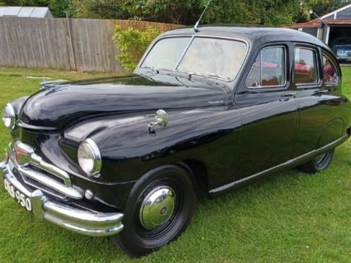
The first Vanguards had a 1.8-litre unit based on a Ferguson engine – in December 1945, Standard had signed an agreement to build tractors under licence. When full production began in May 1948, power was from a 2,088cc ‘Big Four’ unit. Your friendly local Standard dealer could boast of the Vanguard’s independent front suspension, hydraulic braking system, and how it looked far more contemporary than the outgoing Fourteen saloon.
That year, The Times subjected the Vanguard to a 400-mile test and thought it “confirmed the high hopes raised by its promising specification.” They were also impressed by its 75-mph top speed – more than reasonable when the first motorway was a decade in the future. However, just before you decided to invest your Services’ gratuity in a new Standard, you had to join a waiting list that might last for three years.
The Vanguard was “Made in Britain; Designed for the World”, and an advertisement warned motorists that it was “for export only during 1948”. A company had to export a minimum of 75% of its output to be eligible for a quota of steel. One reason for Standard using a box-section chassis for the Vanguard was ease of CKD - “Completely Knocked Down” - kit assembly in overseas plants.
Meanwhile, those fortunate enough to take delivery of a new car had to sign a covenant stating they would not sell it within 12 months. As for everyday motoring, despite the government restoring the basic petrol ration for private motorists in June 1948 - they withdrew it the previous year - this still meant only 90 miles per month.
But the Standard Vanguard anticipated a brighter future – one free from coupons, waiting lists, and demob suits.
In late 1951, Standard facelifted the Vanguard, and the Phase 1A gained a new radiator grille and a larger rear window. Two years later, the Phase 2, with its ‘three-box’ saloon bodywork, replaced the original ‘Beetleback’ styling, making Bryan’s Phase 1A one of the last examples.
By then, motorists had cause for optimism. Petrol rationing had ended in 1950, and while exports were still a major priority of the UK car industry – in 1952, out of 448,000 new vehicles, 308,942 were destined for overseas – waiting lists were shorter, and the new car covenant was no more. A new Vanguard could at last be within reach, the proud owner regarding it as more dignified than a Ford Zephyr-Six or a Vauxhall Velox, and slightly more dynamic than an Austin A70 Hereford.
And Vanguards such as Bryan’s deserve to be remembered as the UK motor industry’s first ‘World Car’. Or, as Standard modestly put it, the Vanguard was “Built by the finest engineering craftsmen, and tested under the most arduous conditions, here is a car that truly represents in every detail of its design ‘all that’s best from Britain’”.
With thanks to Bryan for his time.
With thanks to Bryan for the permission to use the images in this blog.