
“As Old As The Industry, As Modern As The Hour” - The Riley Two-Point-Six
12 March 2026
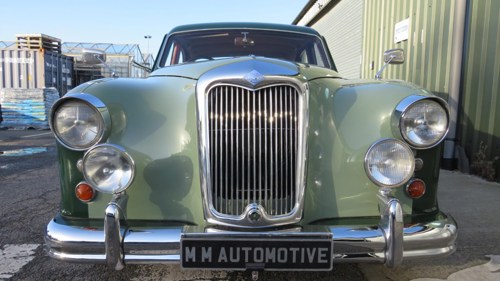
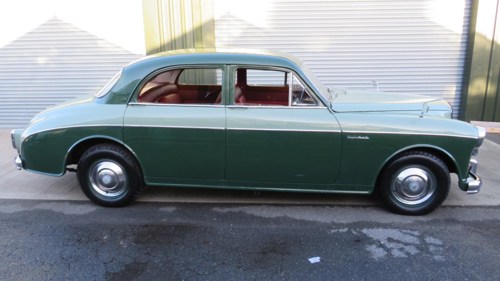
Had the British Motor Corporation used the Riley name with greater acumen, the Two Point Six could have founded a dynasty of sports saloons to rival Jaguar, Rover, BMW, and Lancia. As it is, this Shannon Green/Leaf Green 1959 example sold by M and M Automotive - is a reminder of what might have been.
The narrative starts at the 1953 London Motor Show, with the launch of the Riley Pathfinder, the third design Palmer created for the Nuffield Group, after the Wolseley 4/44 and the MG Magnette ZA. The first large sports saloon from the British Motor Corporation, following the 1952 Austin/Nuffield merger caused great interest but some Riley devotees regarded the Pathfinder with suspicion.
For one, the Pathfinder had cam and roller steering as opposed to the RMF’s rack & pinion. Secondly, it seemed too closely related to its MG and the Wolseley stablemates. Nuffield had acquired the marque but, up until 1953, had retained its independence within the group.
However, your friendly local Riley dealer might have pointed out the Pathfinder was powered by the marque’s famous 2.5-litre ‘Big Four’ engine, and the torsion bar and wishbone independent front suspension of its RMF predecessor. It also featured rear coil springs, radius arms, and a Panhard rod.
The 1954 London Motor Show saw the launch of the Wolseley 6/90, which had a bodyshell, boot lid and front doors in common with the Pathfinder. The new Wolseley also had smaller wheels and a two-inch higher ride height, giving it a more formal look, while power was from the six-cylinder 2,639cc C-Series engine.
Unfortunately, early Pathfinders had suffered from unreliable servo-assisted Girling ‘Autostatic’ brakes. In addition, the Corporation subcontracted chassis assembly to the Wolverhampton firm John Thompson, whose alignment and welding processes was not to Riley standards. These issues were largely resolved by 1954, when Gerald Palmer and his Riley team planned the RMJ, a modified Pathfinder with disc brakes and a 3-litre overhead-cam version of the C-series engine.
Palmer thought the RMJ would “out-Jaguar the Jaguar”, but in 1955, Leonard Lord, BMC’s Chief Executive, fired him as the Corporation’s Chief Engineer, using a not entirely positive Autocar test of the 6/90 as a pretext. The RMJ was never to enter production, and the final Pathfinders before sales ended in 1957 used the Wolseley’s rigid rear axle and leaf springs.
The Pathfinder’s replacement was the Riley Two-Point-Six, which was essentially the 6/90 Series III with a slightly more powerful engine and diamond badges. The two had very different images; the Wolseley was for Raymond Huntley-style bank managers and B-film detective inspectors, while the Riley was for David Niven types in jaunty cravats. To further emphasise their differences in appeal, the Two-Point-Six had flashing indicators, while home market 6/90s retained semaphore trafficators!
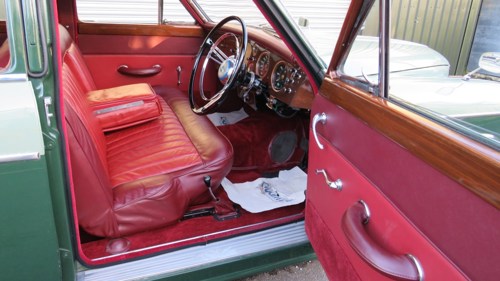
The luxury car to be proud of “through and through” - and that was “created for enthusiasts…for enthusiasts” cost £1,411 7s, so the owner would naturally expect a high standard of appointments. The-Two-Point-Six boasted fog and reversing lamps, full instrumentation, an adjustable steering column, and hide upholstery. The gear lever occupied a cutaway in the front bench to the driver’s right. Palmer originally devised this feature for the Pathfinder to allow for a bench front seat.
Two-Point-Six enthusiasts will extol its comfort and performance, but by 1957, the writing was already on the wall for large Riley saloons. When BMC introduced the 3-Litre ‘Farina’ range in 1959 to replace the 6/90, the Austin A95/A105 Westminster, and the Austin Princess IV DS7, there was no diamond-badged model. The Riley name lasted until 1969, a victim of BMC’s corporate neglect.
As it is, the Two-Point-Six has to be one of the finest-looking saloons of its era. Palmer reflected, “I had been to several Continental shows and had realised that some Italian styles were wonderful. British styling, by comparison, was just pathetic”.
And the Riley Two-Point-Six, with its touches of the Lancia Aurelia Berlina, looked as though it was poised for a trip along the A27 to Goodwood.
With thanks to M and M Automotive for their time.
With thanks to M and M Automotive for their permission to use the images in this blog.