
CELEBRATING THE BASE MODEL BRILLIANCE CAR CLUB
12 March 2026
Siôn Hudson is a very well-known car collector, and his latest initiative is the Base Model Brilliance Car Club – celebrating “The Joy of Automotive Misery!”. This is an organisation for oft-neglected entry-level models, where the suffixes ‘E’, ‘City’, or ‘Popular’ rate far more highly than their Ghia, GXL, and GT stablemates. As Siôn puts it:
I just wanted a place where people could revel in the lowlier models of the automotive world. A base model often gives you only the bare essentials of a car and, therefore, is probably the best way of being able to judge that car on its purest merits.
And a base model, sans adornments, can often lead to a greater appreciation of its styling. Think of the bottom-of-the-range Princess 1800 ‘Wedge’ sans vinyl-clad C-pillars; Harris Man’s striking design au naturelle. Similarly, the Ford Cortina Mk. V ‘Base’ looks smartly minimalist compared to the more elaborately equipped versions.
Ford GB seemed to be the master of the base model, starting in 1953. Their Popular 103E was the cheapest ‘full-size’ car in the UK, so what did it matter if it lacked a heater, a passenger windscreen wiper, an adjustable passenger seat, and indicators? The solitary wiper was suction-powered and without a vacuum reservoir; under certain conditions, it was known to grind to a halt.
Siôn remarks that:
There is also a social history element of base cars: in days gone by, it was often very clear that you had bought the base due to badges such as ‘Merit’ or ‘Popular’ or ‘City’. Everyone knew that you could not afford any better because of the badge on the back. But equally, a lot of people were simply satisfied with a car that just worked and got them from A to B.
The status of the Ford Sierra ‘Base’ was made exceptionally clear: “From outside, you’ll recognise it by its special wheels and different grill and bumper treatment. The whole nose section is in dark grey”. Entry models such as the Sierra Base were often the province of company fleet managers and served as an incentive for junior employees. If an Escort Mk. II Popular driving sales representative aspired to the dizzying heights of a Popular Plus with a dipping rear-view mirror, reversing lamps and cloth upholstery; they needed to work jolly hard.
Meanwhile, the Austin Montego ‘Base’ had no clock, low fuel warning lamp, intermittent wiper speed, rear grab handles, or boot light. After all, there was no point in quelling initiative by cosseting the junior employees. A few years earlier, the 1977 British Leyland brochure contained a display of the Princess line-up reminiscent of the 1966 The Frost Report ‘Class Sketch’:
“I am a 2200HLS - I look down on them”.
“I am an 1800HL - I look up to him, but I look down on him”.
“I am an 1800 ‘Base’ - I know my place”.
In addition, these are the cars that so many people have experienced. As one who grew up in the 1970s, a Morris Marina 1.3 S2 De Luxe, with its “knit-backed vinyl” upholstery, was far more frequently encountered than a 1.8 HL or GL. Triumph Toledos and Dolomites 1300s were everyday sights, while the Sprint was for dashing young solicitors or estate agents who thought that they were Lewis Collins.
A further reason for this club’s success is that few base models appear to survive in their original condition; Mini 850s transformed into not-very-convincing Cooper replicas, or Ford Capri 1300L Mk.Is retro-converted into 3000E clones. Such illusions only worked if they were seen on a foggy evening, and even then, if the owner never turned the ignition key. The writer also recalls seeing a Vauxhall Nova in full ‘Chav’ regalia in Southampton circa 1995. Unfortunately, its owner had neglected to remove the ‘Merit’ tailgate badge.
Siôn further observes:
There is also the marketing element: is the ‘Base’ actually a means of upselling? For example, the Fiesta might be available from £5995 - what a deal! But when that has enticed you into the showroom, there is an L on display with power steering, electric windows, and central locking. None of these features you could really live without. So you buy an L for £7400.
Jaguar used the same principle in 1955 when they launched the Jaguar 2.4 saloon. The ‘Special Equipment’ version featured a cigar lighter, a heater, twin fog lamps, a rear folding armrest, windscreen washers, door-operated courtesy lights, a clock, a rev counter, and the ‘Leaping Cat’ bonnet mascot. The ‘Standard’ 2.4 lacked all these features and proved so unpopular that Jaguar built only 14 examples, all for internal use.
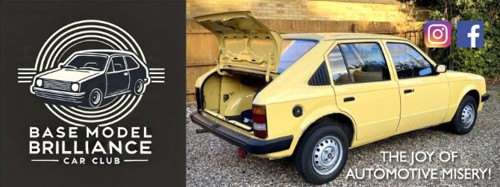
Of course, some base versions were more often seen in publicity material than on the road – such as Siôn’s Vauxhall Astra 1200S 4-Door E. General Motors had cancelled plans for a ‘three-box’ saloon version, and so by 1980 the standard body was available in two and four-door guise.
The decision appeared logical; 46 years ago, ‘traditionally minded’ drivers did tend to regard hatchbacks as distressingly modern as Adam and The Ants. Nor would the Astra E distract the owner with frivolous luxuries, i.e., halogen headlamps, rear ashtrays, a glove box lid, hazard warning lights, and front head restraints.
Today, Siôn’s Astra, as with every vehicle in the Base Model Brilliance Club, is a fascinating reminder of a lost motoring world. The various Merits, Populars, and Citys are as important to automotive history, if not more so, than their more expensive counterparts. Long may the Club prosper.
With thanks to Siôn Hudson for his time.
With thanks to Siôn Hudson for his permission to use the images in this blog.