
The Ford Fiesta At 50
28 May 2026
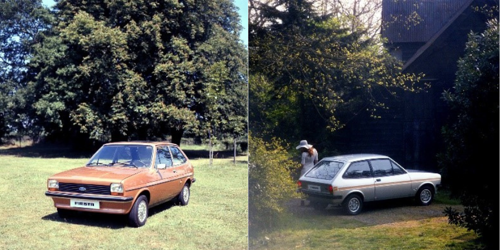
On the 12th of June 1976, Ford unveiled the Fiesta at the 24 Hours of Le Mans. Here to celebrate are 50 facts about one of the most important cars to wear the blue oval badge:
- The Fiesta was the second Ford front-wheel-drive car after the 1962-66 Cologne-built P4-Series Taunus.
- Shortly after the Mini’s launch in 1959, Ford GB dismantled one “down to the last spot weld" and concluded that it could not make a profit for the British Motor Corporation.
- By the 30th of September 1969, Ford of Europe contemplated building a ‘supermini’.
- One impetus behind the idea was Ford’s lack of a model in the sub-Escort category, harming its sales in mainland Europe.
- Ralph Peters, Ford GB’s Vice President of Product Planning, established a group that reported Ford could sell 300,000 cars in this class per year.
- Several branches of the Ford empire commenced their own ideas for a small car. It was the design by Ghia of Turin (which Ford acquired in 1970) that attracted the most attention.
- Project Bobcat commenced on the 15th of September 1972.
- Ford also considered a small Escort-based rear-wheel-drive car named the Cheetah.
- At the end of 1972, Ford staged a customer clinic, which crystallised their decision to make their small car front-wheel-drive.
- Ford evaluated 48 potential competitors during Bobcat’s development.
- Sales projections were now in excess of 450,000 units per year, the majority of which were believed to be first-time Ford owners.
- Various forms of ‘Kent’ engine were tested in Fiat 127 bodyshells.
- The Bobcat was to be under 12 feet long, weigh less than 700kg and have a 7ft 6ins wheelbase.
- Ghia’s chief stylist, Tom Tjaarda, devised the bodywork.
- Ideas for names included Bambi, Bebe, Bravo, Bolero, Cherie, Chico, Forito, Metro, Pony, and Tempo.
- Bobcat was not an option as Ford already used it on the Mercury-badged Pinto.
- Sierra was another rejected name.
- Bravo seemed to be the preferred name, but on the 19th of December 1975, Ford announced: “its new small car developed under the codename Bobcat will be called the Ford Fiesta”.
- Henry Ford II opted for ‘Fiesta’, which means festival, party, or celebration, and highlighted Ford’s new factory in Valencia.
- In December 1975, Fiesta engine production began in Spain.
- Ford of Europe’s Vice Chair Walter Lutz told the press: “Right from the start our aim has been to build a good small car and not just a cheap car”.
- Development costs exceeded £400 million, and the Fiesta represented the largest single production investment in the history of the Ford Motor Company.
- Terence Beckett, Ford GB’s Managing Director, told The Observer that “It is only with large volumes – really large volumes – that the phenomenal development and manufacturing costs can be spread significantly to make prices competitive and profits realistic”.
- Production began in May 1976.
- 25. Ford GB did not display the Fiesta at the 1976 London Motor Show; the UK launch was not until the 2nd of February 1977.
- UK and Irish-market Fiestas were made in Dagenham; Ford moved production of the RHD Granada to Cologne to create extra factory space. Ford stated this would create more than 3,000 jobs in Dagenham.
- The Fiesta’s components were sourced throughout Ford of Europe’s factories in Dagenham, Cologne, Valencia and Saarlouis in Belgium.
- 380 Ford GB main dealers received training in servicing a front-wheel-drive transverse engine car.
- By February 1977, over 2,500 Ford GB mechanics and 300 service managers were instructed in how to maintain the Fiesta.
- 1,100 prospective buyers took part in 14 research clinics.
- 31. The UK television launch advertisement, voiced by the great Patrick Allen, commenced on the 1st of February 1977 and aired 11 times that week. It promised motorists a “very advanced baby”.
- Ford GB aimed for a 4.5% market share with the new Fiesta, with two-thirds of that share coming from conquest sales.
- The dealer information pack modestly stated, “The Fiesta is the most attractively styled small car ever”.
- Dealers were also reminded that “almost 2 million small cars were bought in 1975 in Western Europe, and not one of them was a Ford”.
- Ford predicted three main types of buyers. The first was “the Owner of a Small Car”.
- The second was the “Add-On Buyer”, who might be considering a second car for the first time.
- The third was “The First Time Buyer”.
- Sales of the Fiesta should be retail, not fleet, as “that is and will remain Escort territory”. Ford considered the Fiesta was “not a ‘natural’ fleet car”.
- The Fiesta’s initial line-up included two 957cc and 1,117cc engine options and four trim levels.
- The cheapest Fiesta was the £1,856 ‘Base’ with seats in “sensible fluted vinyl”, “a comprehensive heating and ventilation system with a two-speed booster fan”, and a “front package tray and storage pocket”.
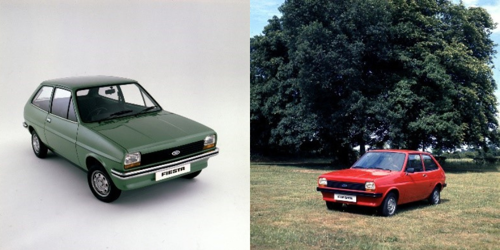
- Next, the £2,079 L offered the discerning motorist a driver’s door mirror, a heated rear window, “Houndstooth” fabric trim, inertia reel front seat belts, reclining front seats with a choice of five positions, rear grab handles, fresh air vents, a reversing light and halogen headlamps. There was also a “rear package tray which lifts up with the tailgate”, and the 1.1-litre version cost another £100.
- The £2,360 1100S boasted “sports suspension”, an anti-roll bar, “bold Cadiz fabric trim”, a glove box lamp, a cigar lighter, a “super-accurate quartz clock”, a rev counter, a trip recorder, black bumpers, and, of course, go-faster stripes.
- The flagship 1100 Ghia cost £2,757 and featured cast alloy wheels, a MW/LW radio, tinted glass, “Crushed Velour and Verona” upholstery, and even a “Mahogany effect instrument binnacle”.
- Colour choices ranged from Signal Yellow, Laurel Green and Diamond White to metallic Roman Bronze, Velvet Red and Arizona Gold.
- Motor thought the Fiesta S was “a good car, but one which does not set new standards, particularly in refinement”.
- Autocar believed “The Fiesta has set some very high, new standards; it could well set some problems for those who have to follow”.
- The Times regarded the Fiesta as “The best model in the current Ford range”.
- The Observer considered it “A very strong contender in the ever-tougher small car battle”.
- Fiesta sales reached the 500,000 mark in 14 months.
- 27 months after launch, Fiesta sales exceeded one million.
With thanks to Christian Brown of Ford for his time.
With thanks to Christian Brown of Ford for the permission to use the images in this blog.