
70 Years of the Austin A35
02 October 2026
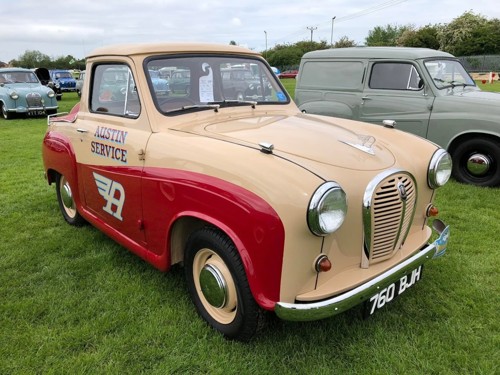
1. The A35 was a star of Stand 157 at the London Motor Show.
2. The Austin sales team could tell you that the A35 featured the 948cc British Motor Corporation A-Series engine in place of the A30’s 803cc unit.
3. A typical annual wage for 1956 was £624.
4. One motoring innovation for 1956 was Double Yellow Lines - first seen in Slough on the 12th of February.
5. New television programmes for 1956 - Hancock’s Half Hour and the quite brilliant-sounding Tea with Noele Gordon.
6. No,1 in the Hit Parade on the 2nd of October 1956 - Lay Down Your Arms by Anne Shelton.
7. BMC tested the A-series engine on the Autobahnen of Germany.
8. Other A35 improvements incclued an enlarged rear screen.
9. The A35 saloons also boasted amber flashing indicators but the Countryman and Van retained semaphore trafficators.
10.Standard equipment included a “useful courtesy light” under the dashboard.
11.The driver's seat had fore and aft adjustment to a choice of five positions, the front passenger seat to three positions.
12.The Motor found their A35 test car was capable of 0-60 mph in 30.1 seconds.
13. BMC told potential buyers “Life Is More Fun With An Austin A35”.
14. Furthermore, the A35 does “over 70 mph”.
15. The A35 was capable of over 50 mpg - very useful as the Government reintroduced fuel rationing from 17th of December 1956 to 14th of May 1957 in the aftermath of the Suez Crisis.
16.Meanwhile, Austin informed its dealers that "the A35 has many new features which when added together lead to only one conclusion - the A35 is the indisputable leader in its class”.
17. A35 prospects include “OLD CUSTOMERS”, while “PROFESSIONAL MEN MIGHT WANT A SECOND CAR”.
18. In addition, “all shopkeepers are good prospects for an A35”.
19. Remember - ‘Professional People’ were “TWO CAR buyers but don't forget they're good prospects for A95, A105 and yes - a few will buy a Princess ! !”
20. Dealers should also highlight how a “new sports car type gear lever, such as is usually found only on expensive cars, has been installed. It is a sheer delight to use”.
21. Plus, “A re-designed radiator grille lends greater distinction and appeals to the discerning, fashion conscious portion of the buying public”.
22.Suggested sales slogans ranged from “Cruise and enthuse in your New Austin A35” to “The Austin Engineers abilities are approved by men of discernment today”.
23. At £541 7s, the A35 two-door was cheaper than its BMC stablemate, the Morris Minor 1000 two- door for £602 17s.
24. The A35 four-door cost £573 12s.
25. The A35 De Luxe featured ashtrays, over-riders and hinged rear windows on the two-door model.
26.The A35 two-door De Luxe was £554 9s 6d and the four-door De Luxe was £578 13s 3d.
27. Both the A35 and the Minor were powered by the A-series engine, but the Morris had a Zenith carburettor and the Austin an SU.
28.Hire Purchase regulations meant an A35 two-door could be yours with a £110 deposit.
29. Another rival was the Ford Popular 103 - £413 17s which made it the UK’s cheapest new car, but it had a design that harked back to 1938.
30.The Ford Anglia 100E at £574 7s looked more up-to-the-minute but lacked the Asutins overhead-valve engine and electric windscreen wipers.
31. The Standard Family Eight was £569 17s - very reasonable for a four-door saloon but it was devoid of an external boot lid.
32. Neither the Rootes Group nor Vauxhall would offer a small car until 1963.
33.Another small four-door saloon was Citroën’s Slough-built 2CV but it was costlier than the A35 at £598 7s and far too bohemian for many respectable British motorists.
34. From overseas, the Volkswagen Beetle ‘Standard’ was £635 2s.
35. The Fiat 600 was £620 2s.
36.The Renault Dauphine (Acton-assembled from 1957-1961) was a formidable £769 7s.
37. At £683 17s the Morris Minor 1000 Traveller was £45 more expensive than the Austin A35 Countryman.
38. The sales copy raved: “ Buyable! Eyeable! Reliable! The slickest little car that ever wheels on the road and the best means of travel for the motorist of modest means”.
39. Not to mention that the Austin A35 was “the small car that is setting the pace for extra-economical family motoring”.
40. Those motorists in need of more power could have Speedwell Performance Conversions of London convert their A35 - call SPEedwell 6960 for more details.
41. John Bolster of Autosport found the Speedwell A35 capable of 0-60 in 15.6 seconds.
42. In 1958 Graham Hill's first new car was a Speedwell Austin A35.
43. By 1959 Speedwell A35 prices started from £635.
44. For those with more need for space than speed, the A35 Van offered 60 cubic feet of load space.
45. Restall Brothers of Birmingham could sell you a rear bench kit for your A35 Van for a mere £14 10s - telephone VICtoria 4937 for more details.
46. Such conversions were popular as they did not attract Purchase Tax.
47. Unlike the A35 Countryman, the A35 Van had a roof vent.
48. In 1956, BMC also introduced the A35 Pick-Up - “the solution to a long-felt need for light transport among the many small businesses of today”.
49. The A35 Pick-Up was based on the two-door saloon, rather than the A35 Van, so its owner benefitted “from easier cab acces” and “car-type comfort”.
50. The Pick-Up lacked a tailboard but had a seat incorporated in the floor of the rear compartment.
51. BMC claimed this feature was “an ideal arrangement for switching labour quickly from one spot to another”.
52. Access to the seat was via the grab bars and “steps incorporated into the rear bumpers”.
53. Unlike the A35 Van, the A35 Pick-Up ad a front passenger seat as standard equipment.
54. The rear seat attracted the attention of HM Customs and Excise, who declared the Pick-Up was not a light commercial but a car - and therefore liable for Purchase Tax.
55. Consequently the A35 Pick-Up was more expensive than the Morris Minor Pick-Up - £584 17s as opposed to £433 12s 5d - and also nearly £162 more expensive than an A35 Van.
56. A35 Pick-Up production ended in 1957 after just 475 examples; much of the unsold stock was sent to Australia and New Zealand.
57. BMC discontinued the two and four-door A35s in April 1959.
58. 1959 saw the filming of Carry On Constable, with an A35 Van pursuing a 1951 Plymouth Cambridge.
59. By February 1962 the Countryman was the last British car fitted with trafficators.
60. That month, the Van and Countryman gained flashing indicators and lost their elaborate front door pressings.
61. In September 1962 BMC discontinued the Countryman and the A35 Van was now fitted with the 1,098cc A-Series engine.
62. The Van was available with the 948cc A-Series engine from October 1963 onwards, and the 1,098cc unit ceased to be available by May 1966.
63. 1966 also saw an A35 Van take part in a low-speed case with a Land-Rover in The Deadly Bees; a film about as good as its title.
64. Wiltshire Constabulary use the A35 Van for rural patrol duties
65. The Royal Automobile Club also used the A35 Van.
66. The GPO evaluated two A35 Vans.
67. The A35 Van remained in production until February 1968, being replaced by an Austin-badged version of the Minor Van.
68. James Hunt famously owned a 1967 A35 Van.
69. BMC made 13,320 A35s in CKD - completely knocked down - form.
70. Total A35 production was 354,607 units.
With thanks to Harry Douglas of the Austin A30/A35 Owners' Club for his time.
With thanks to Harry Douglas for the use of the images in this blog.